

As an Amazon Associate we earn from qualifying purchases.
For regular leather bag and upholstery work, start with the JUKI DNU-1541S and a suitable servo-motor setup. For occasional soft leather alongside everyday sewing, the Janome HD3000 is a more practical home option. If you need walking-foot feeding in a machine you can put away, consider the Consew CP206RL. The best sewing machine for leather depends on the complete seam you need to sew: its stiffness, number of layers, thread, and shape.
Industrial compound feed for repeated bag, upholstery, and layered leather seams.

A mechanical household machine for soft leather accents and general sewing.

Built-in motor and walking-foot feeding for a compact leather and canvas station.
| Machine | Class and feed | Best reason to buy | Main limitation |
|---|---|---|---|
| JUKI DNU-1541S | Industrial; compound feed | Repeated layered leather seams | Permanent table; setup and servicing required |
| Janome HD3000 | Domestic; bottom feed | Soft leather plus everyday sewing | Not intended as a thick-leather production machine |
| Consew CP206RL | Portable; walking foot | Compact leather and canvas station | Heavy to carry; smaller workspace; straight stitch only |
| Janome HD9 Professional | Tabletop straight stitch; bottom feed | Speed control and heavier topstitching thread | Optional leather feet; no built-in compound feed |
| Consew 206RB-5 | Industrial; compound feed | Upholstery, large bobbin, long seams | Full workstation; limited access inside closed shapes |
| SINGER 4532 | Domestic; bottom feed | Lower-cost general sewing with speed control | Light leather only after testing; limited thread range |
A garment panel or small soft pouch is a different job from a stiff belt. The HD3000 and SINGER 4532 retain the stitch choices and convenient size of a home machine. Use the correct needle and compatible machine thread, and check feeding on a realistic sample. A roller or non-stick foot can reduce surface drag. If you already own a capable machine, try that setup before buying another domestic model.
In a compound-feed machine, the needle travels with the material while the feed dog and alternating feet help move the layers. That is especially useful when leather grips the foot or several layers creep out of alignment. The JUKI DNU-1541S and Consew 206RB-5 belong here. A bolt-on even-feed foot on a domestic machine does not reproduce this mechanism. Our walking-foot sewing machine guide covers the broader category.
Do not assume any of these machines will sew every leather project. Thick vegetable-tanned assemblies can require a heavier leather stitcher, while a cylinder arm helps access small tubes and formed bags. Send the seller a representative sample with your intended thread size before investing. A successful demonstration of the actual seam is more useful than a video of a needle piercing a flat stack.
Key details: Industrial flatbed · compound/unison feed · straight stitch · up to 9 mm stitch length · safety mechanism.
The DNU-1541S is the strongest starting point here for a dedicated leather workstation. Its needle feed, bottom feed, and alternating feet help move a layered seam together, which matters when a bag panel meets a strap or a folded edge. JUKI specifies a double-capacity hook and a safety mechanism that disengages when a hook jam occurs. These are useful working features for repeated seams, rather than extra decorative stitches.
Buy the whole setup carefully. The linked package lists a servo motor and table and is sold as a DIY assembly package; check the seller’s current contents, assembly requirements, and support. For detailed leatherwork, a controllable low-speed setup matters more than the maximum 2,500 stitches per minute. The S model should not be confused with the DNU-1541-7 and its automatic trimming features. This flatbed also is not a universal answer for thick holsters or closed bag gussets.
Key details: Domestic mechanical machine · 18 stitches · adjustable foot pressure · free arm · hard cover.
The HD3000 makes sense when leather is part of a broader hobby: a soft pouch, garment trim, or an occasional accessory alongside normal fabric sewing. Janome provides a model-specific leather sewing guide, including needle, thread, stitch-length, and foot-leveling advice. The simple controls and adjustable presser-foot pressure give you useful ways to tune the seam without moving to an industrial table.
Its feed dogs move the material from below; this is not built-in compound feed. A high foot lift lets you position material but does not establish how much leather the machine can stitch reliably. Test the thickest folded junction of your project, and consider a compatible Ultra Glide foot if the surface drags. Choose the JUKI or Consew industrial model when leather becomes frequent work, the layers shift, or the thread you need exceeds a household machine’s range.
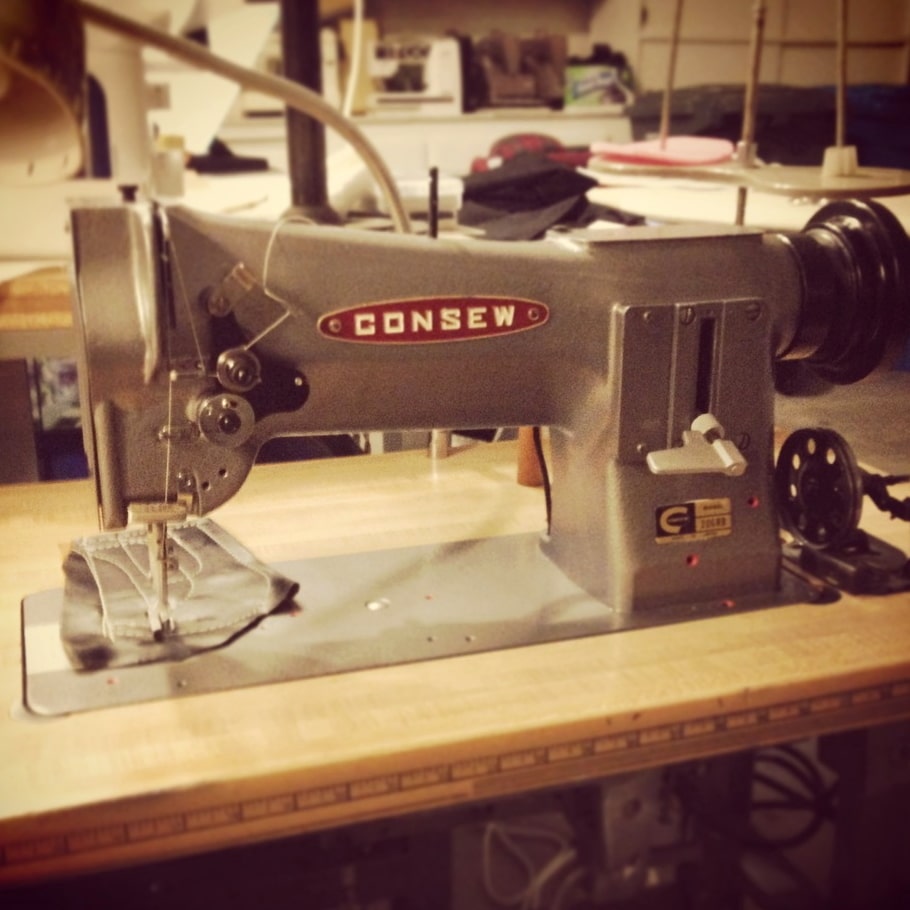
Key details: Portable straight-stitch machine · walking-foot feed · reverse · up to 6 mm stitches · 7-inch underarm space.
The CP206RL offers walking-foot feeding without requiring a permanently installed industrial table. Consew lists leather, vinyl, canvas, bags, and upholstery among its applications. Its built-in motor and carry handle make it easier to store between projects, while the 6 mm stitch-length range is useful for visible seams. It is a practical middle ground for a maker whose compact household machine no longer feeds layers evenly.
Portable does not mean lightweight: Consew lists this model at about 41 pounds. It also has a smaller working area and a different feed mechanism from the compound-feed 206RB-5; do not treat the similar numbers in their names as equivalent capacity. Choose it for manageable flat projects and occasional heavier work, after testing your exact seam stack. It is straight-stitch only; the separately named CP146RL is the zigzag version.
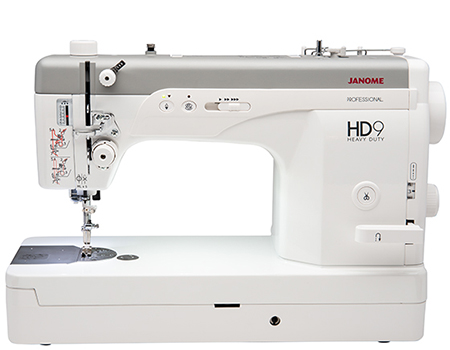
Key details: Straight stitch only · speed slider · needle up/down · 6 mm maximum stitch length · jumbo bobbin.
Choose the HD9 when you want a substantial tabletop machine for clean straight seams and also sew bags, denim, or quilts. The speed slider and needle-position control are useful around corners, while Janome’s heavy-weight thread guide supports its intended leather and topstitching applications. The jumbo bobbin holds 40% more thread than a standard bobbin, reducing changes on longer runs.
Despite its name and industrial-style components, the HD9 uses bottom feed rather than a built-in compound-feed mechanism. Janome offers a separate leather accessory kit with roller and Ultra Glide feet; check what the Amazon bundle actually includes. The automatic cutter also has thread limitations, so follow the manual when using heavier thread. Buy the HD9 for controlled straight sewing on suitable materials; choose an industrial walking-foot setup for recurring bulky leather assemblies.

Key details: Industrial flatbed · compound feed · 10 mm maximum stitch length · large bobbin · safety clutch.
The 206RB-5 is a close industrial alternative to the JUKI, particularly for upholstery and long visible seams. It combines needle feed, bottom feed, and alternating feet, and Consew specifies a large bobbin that can be changed without removing the work. Its locking stitch regulator and adjustable reverse feed help keep stitch settings consistent during repeated jobs.
Choose between this and the JUKI partly on the complete package and the service you can obtain. The Amazon listing includes a table and servo motor, but assembly, motor settings, shipping, and after-sale support depend on the seller. The 10 mm maximum stitch length is useful flexibility, not a reason to use widely spaced stitches on every project. Its flatbed needs room and cannot reach every narrow, already-assembled bag section; a cylinder-arm specialist may suit that work better.
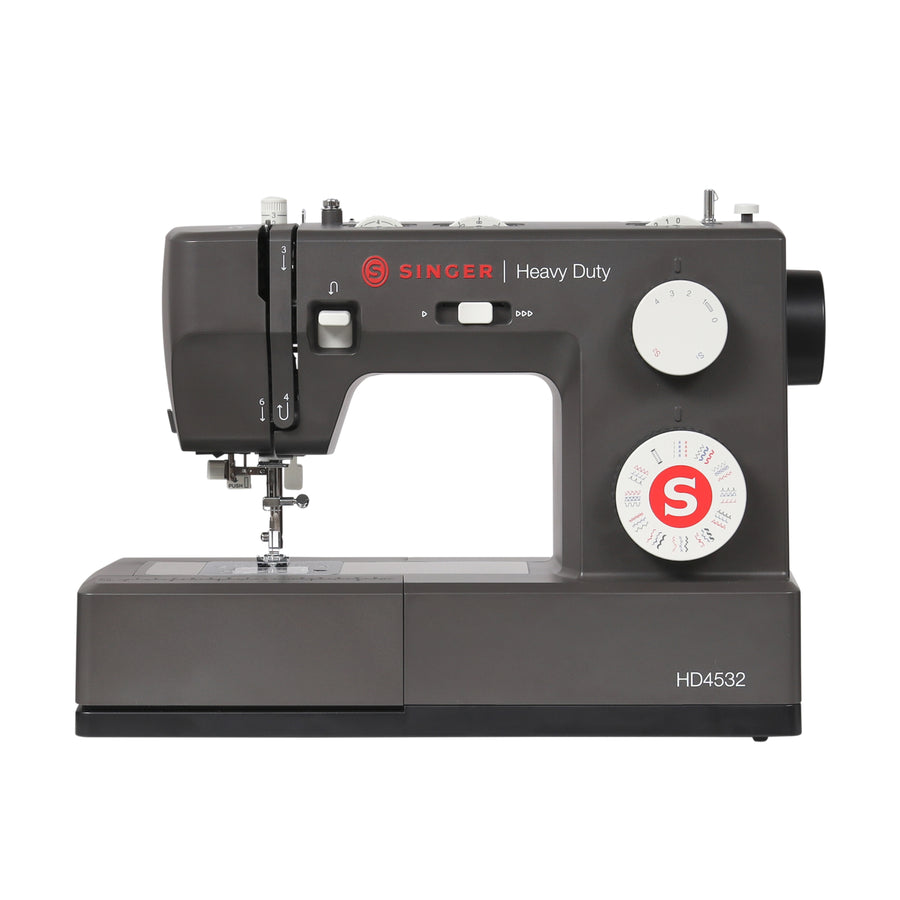
Key details: Domestic machine · 32 built-in stitches · speed control · adjustable foot pressure · 4 mm maximum stitch length.
The 4532 is a sensible budget-conscious choice if most of your sewing is fabric and leather is an occasional experiment. Its maximum-speed control is a useful improvement over the older 4432 for corners and short seams, where an unexpected burst of speed can leave permanent holes. You also get adjustable foot pressure, a top drop-in bobbin, and utility stitches for everyday repairs and garments.
Treat it as a household machine for soft, thin material after a successful scrap test. SINGER’s “Heavy Duty” name does not make it an upholstery production machine, and a non-stick foot improves sliding without adding needle feed. The optional non-stick foot and suitable needles may be separate purchases. Skip this category for stiff belts, thick folded straps, or regular leather orders. Its 32 stitches provide 110 advertised stitch applications; those are not 110 different built-in stitches.
Top speed is rarely the deciding feature for small leather goods. Ask how slowly an industrial package can start and maintain a stitch under load. Servo-motor settings, pulley size, and any speed reducer affect the experience. Also confirm voltage, table dimensions, assembly requirements, delivery arrangements, and who handles adjustment or repair. A machine head alone is not a complete workstation.
Needle system identifies what physically fits the machine; needle size and point must suit the thread and material. Buy the correct system first. A cutting-point leather needle is appropriate for many genuine leathers, but soft faux leather can have a fabric backing that is damaged by that point. SCHMETZ recommends trying Microtex first on soft synthetic leather. Test before sewing visible seams, and never use waxed hand-stitching thread in a machine unless its maker specifically permits it.
Large-looking topstitching thread can exceed a domestic machine’s needle, tension, or bobbin capabilities. Match both top and bobbin thread to the manual rather than forcing a larger needle into the holder. Our thread type finder can help with general thread choices; the machine manual remains the final reference for its supported sizes.
Walking feet can leave impressions on a delicate finish. Test the underside as well as the visible face, use appropriate feet, and adjust pressure within the maker’s guidance. Support the work so its weight does not pull the stitch line sideways. For furniture covers and long leather panels, our upholstery machine guide is a useful next comparison.
Some can sew soft, thin leather with the correct needle, thread, foot, and settings. Success depends on the whole seam, not one layer. A capable domestic machine can be useful for occasional work, but repeated thick assemblies call for a more suitable feed system and thread capacity.
No. “Walking foot” can describe a portable machine’s top-feeding mechanism or an attachment for a domestic machine. Compound feed additionally moves the needle with the material. Compare the actual feed mechanism, not just the label on the listing.
There is no reliable universal number. Soft upholstery leather and stiff vegetable-tanned leather of the same thickness can behave very differently. Folded seams, thread size, feet, and the motor setup also matter. Foot lift is not a maximum sewing-thickness specification; use a representative sample.
For layered leather bags and upholstery, the DNU-1541S is the more relevant type because it has compound feed. The standard DDL-8700 is a bottom-feed industrial garment machine. Industrial speed and a table do not make the two interchangeable.
A domestic machine is more flexible for ordinary garments and occasional soft leather. A heavy industrial setup may use feet, feed dogs, needles, and thread that are poorly suited to delicate fabric. If leather becomes regular work, keeping a separate household machine for clothing is often more practical.
Choose the JUKI DNU-1541S for a dedicated leather workstation, with the Consew 206RB-5 as a closely matched upholstery alternative. Choose the Janome HD3000 for occasional soft leather, the CP206RL when storage matters, or the HD9 for controlled straight stitching and topstitching. The SINGER 4532 is the lower-cost general-sewing route. For every option, test the thickest seam before committing the project.