
The best sewing machine for quilting is not necessarily the machine with the most stitches. For a quilt, workspace, fabric control, needle up/down, free-motion capability, useful feet and how easily the machine moves a quilt sandwich matter much more than a giant decorative-stitch count.
For a beginner or anyone who wants one affordable machine for both normal sewing and quilting, the Brother CS7000X is still an excellent starting point. For someone who already quilts regularly and wants more room, speed and fabric control, the Brother PQ1600S is a much more serious straight-stitch machine. If you want a premium computerized machine that remains useful for garments and decorative sewing, the Janome Memory Craft 6650 is the most versatile step-up here.
These three cover the most common buying decisions without turning the top of the page into a catalog.
| Machine | Type | Max Speed | Quilting Workspace | Free Motion | Best For |
|---|---|---|---|---|---|
| Brother CS7000X | Computerized multipurpose | 750 SPM | Compact domestic throat + included wide table | Yes; drop feed, quilting foot included | Beginners and budget-conscious quilters |
| Brother PQ1600S | Straight-stitch specialist | 1,500 SPM | 5.7 x 8.7 in needle-to-arm; 11.1 x 23.3 in extension table | Yes; free-motion foot included | Serious piecing, straight-line and free-motion quilting |
| Janome MC6650 | Premium computerized | 1,000 SPM | 10 x 4.7 in workspace / all-metal flatbed | Yes; drop feed | Premium one-machine-for-everything setup |
| JUKI TL-2010Q | Straight-stitch specialist | 1,500 SPM | Large auxiliary table; straight-stitch body | Yes; switchable drop feed and quilting feet | Free-motion quilters and straight-stitch purists |
| SINGER C7290Q | Computerized multipurpose | Variable-speed domestic | 6.4 in needle-to-tower + included extension table | Yes; drop feed and darning foot | Feature-rich general sewing + quilting |
If you are deciding between a normal domestic machine, a straight-stitch quilting specialist, a sit-down machine or a long arm, start with the space you actually have. The site’s existing tool below estimates whether your room can accommodate each setup; this article does not add separate calculator code.
Key specifications: 70 built-in stitches; 750 SPM; 10.5 lb; drop feed; adjustable speed; automatic needle threader; wide table; walking foot, quilting foot and 1/4-inch foot included; 25-year limited warranty.
The CS7000X is the easiest recommendation for someone learning quilting because Brother includes the accessories that beginners are often told to buy later. You get a walking foot for feeding a quilt sandwich evenly, a quilting/free-motion foot, a 1/4-inch foot for piecing, a quilt guide and a detachable wide table.
The adjustable speed control is more important than its modest 750-SPM ceiling. When you are learning free-motion curves or trying to keep a quarter-inch seam consistent, being able to deliberately slow the machine down is more useful than owning a 1,500-SPM motor you cannot yet control.
At 10.5 lb, it is also genuinely portable enough for quilting classes. Brother includes a hard protective cover, so this is one of the few machines here that makes sense both as a home machine and a class/retreat machine.
The limitation is space. The wide table supports fabric but the machine still has a compact domestic throat. You can quilt smaller projects and roll/fold larger quilts through it, but a quilter who already knows that throat space is the problem should skip directly to the larger machines below.
Pros
Cons
Best for: first quilts, classes, piecing, smaller free-motion projects and anyone who wants quilting capability without giving up ordinary sewing.
If portability matters almost as much as quilting capability, compare it with the machines in our best portable sewing machine guide.
Key specifications: straight stitch only; up to 1,500 SPM; 23.81 lb; 5.7 x 8.7-inch needle-to-arm area; 11.1 x 23.3-inch extension table; knee lifter; adjustable presser-foot pressure; four feed-dog height settings; pin-feed system; automatic thread cutter.
The PQ1600S is the machine I would buy when quilting has become the main job and a compact computerized machine feels cramped or slow. Brother replaced the older PQ1500-series with this model, and the formula remains intentionally simple: one excellent straight stitch, high speed, a larger working area and more control over how the fabric feeds.
The larger needle-to-arm space gives you more room to bunch, roll and reposition the quilt than a compact domestic machine. The included extension table supports the quilt’s weight, while the knee lifter lets you raise the presser foot without taking both hands off the project—a small feature that becomes extremely useful during free-motion work.
The feed system is unusually configurable for this price class. Brother gives you four color-coded feed-dog height positions, adjustable foot pressure and a pin-feed mechanism that can move layers without relying only on the normal feed dogs. Those controls are more relevant to quilt sandwiches than a menu of decorative stitches.
The tradeoff is absolute: it only makes a straight stitch. That is a strength if you already own another general-purpose machine, but a bad first-machine decision if you still need zigzag, buttonholes and stretch stitches for clothing or household sewing.
Pros
Cons
Best for: frequent piecing, straight-line quilting, free motion and quilters who want a fast specialist without moving to a long-arm frame.
Key specifications: 170 stitches plus two alphabets; 1,000 SPM; 24.25 lb; 10 x 4.7-inch workspace; 10-inch all-metal seamless flatbed; 12 included feet; memorized needle up/down; automatic thread cutter; drop feed; foot-pressure adjustment; 9 mm max stitch width.
The MC6650 is the premium choice here for someone who wants a larger, more stable quilting platform but does not want to give up zigzag, buttonholes, decorative stitches and ordinary sewing. Janome’s 10-inch all-metal flatbed is the central reason to buy it: there is more usable room to the right of the needle, and the rigid surface feels more purposeful around large projects.
It is also faster than compact computerized machines at up to 1,000 SPM. Memorized needle up/down helps with pivoting and free-motion stops, while the automatic thread cutter saves repetitive reaching under a large quilt. Adjustable foot pressure gives you another way to tune feeding for different layers.
The one-push needle-plate system is useful for quilting because you can switch to the included straight-stitch plate without removing screws. A straight-stitch plate supports fabric closer to the needle hole, which can improve feeding and reduce the chance of lightweight fabric being pushed downward at the start of a seam.
The main downside is cost. If your quilting is occasional, the CS7000X can complete many of the same projects for far less. The MC6650 earns its premium when you will actually use the larger workspace, speed, stability and convenience controls for years.
Pros
Cons
Best for: dedicated quilters who still want one premium machine for garments, decorative sewing and general household work.
If you already prefer Janome, see our best Janome sewing machine guide for the broader lineup.
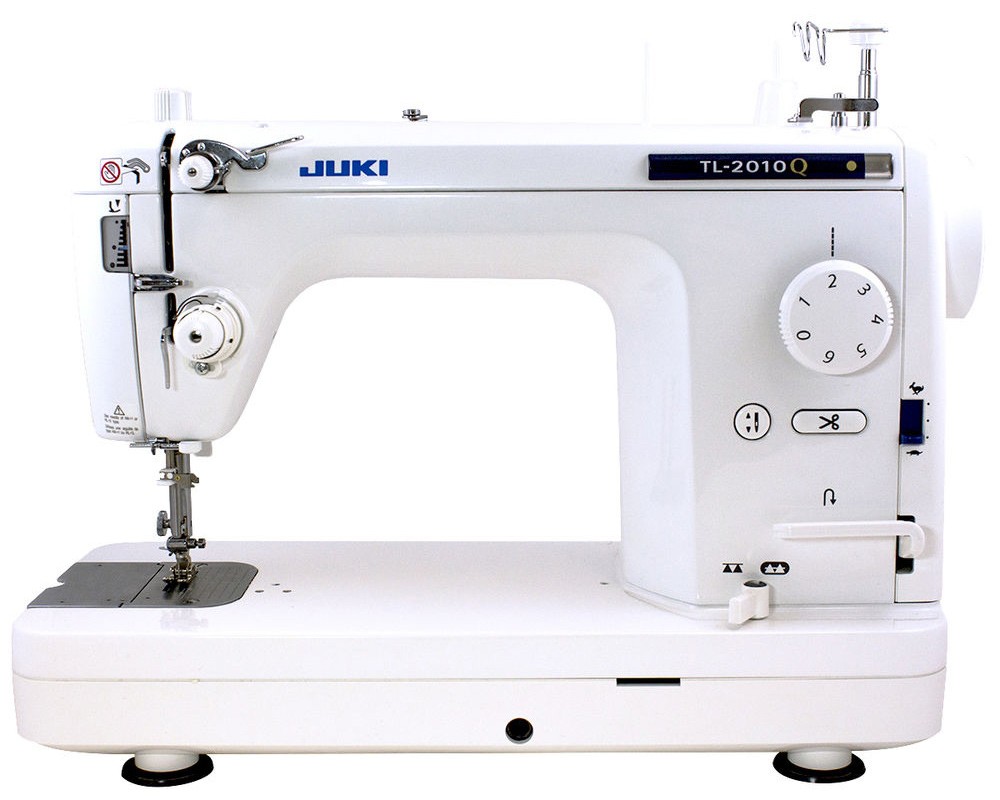
Key specifications: straight stitch only; up to 1,500 SPM; 25.4 lb machine-only weight; 6 mm max stitch length; switchable drop feed; knee lifter up to 12 mm presser-foot lift; automatic thread trimming; speed-control lever; auxiliary table.
JUKI’s TL-2010Q is the other serious straight-stitch choice, and I prefer it specifically for someone who expects to spend a lot of time free-motion quilting. JUKI makes lowering the feed dogs a simple switch operation and offers dedicated 1/4-inch and 1/5-inch quilting feet along with an even-feed foot for difficult layers.
The machine runs up to 1,500 stitches per minute but includes a speed-control lever, which makes that power easier to tame. That matters for free motion because the ideal speed is not simply “maximum”; it is the speed at which your hand movement and needle speed produce consistent stitches.
The knee lifter raises the presser foot as high as 12 mm, letting you reposition bulky fabric without taking your hands away from the quilt. JUKI also gives you button/foot-controller thread trimming, which becomes a meaningful convenience when you are repeatedly starting and stopping across a large top.
Like the Brother PQ1600S, it only straight-stitches. If you need one machine to sew knit garments, buttonholes and zigzag finishes as well as quilts, buy a computerized multipurpose model instead.
Pros
Cons
Best for: free-motion quilting, straight-stitch piecing and experienced quilters who want a fast, simple specialist.
If an even-feed foot is central to your projects, our walking-foot sewing machine guide explains where a walking foot helps and where a true compound-feed machine is different.
Key specifications: 417 stitch applications; 12 included quilting/sewing feet; extension table; 6.4-inch needle-to-tower sewing space; drop feed; walking foot, 1/4-inch piecing foot and free-motion darning foot included; built-in thread cutter; speed control; 14 lb; up to 25-year warranty coverage.
The C7290Q is a better current Singer reference than relying on the older Quantum Stylist 9960 in a 2026 refresh. Singer packages it specifically for sewing and quilting, and the included accessory set is unusually relevant: walking foot, quarter-inch piecing foot, free-motion darning foot, extension table and quilting guide are all useful out of the box.
One marketing detail deserves clarification. Singer advertises 417 stitch applications. That is not the same thing as 417 individually selectable built-in stitches; Singer defines an application as a technique you can perform with a stitch. For quilting, the exact count is less important than having the utility stitches, feed controls and quilting feet you will actually use.
The 6.4-inch needle-to-tower space is fine for smaller quilts and piecing, but it is not generous compared with the Janome’s 10-inch work area or dedicated straight-stitch machines. Buy this machine because you want a feature-rich general sewing machine that comes quilting-ready—not because you want maximum throat room.
Pros
Cons
Best for: Singer buyers who want one computerized machine for quilting plus normal sewing without moving into a large premium machine.
For a broader brand-level comparison, see our updated Brother vs SINGER guide.
Once the quilt is assembled, much of it must pass to the right of the needle. More throat space means less rolling, folding and compressing. A wide extension table supports the portion outside the machine, but it cannot change the physical needle-to-tower opening.
A walking or even-feed foot helps move the quilt top, batting and backing together from above while the feed dogs move them from below. It is especially useful for straight-line quilting and long seams where layer shifting would otherwise create puckers.
For traditional free-motion quilting, you lower or disengage the feed dogs and move the quilt yourself. The machine must support that mode, and an appropriate free-motion/darning foot makes the needle area safer and easier to see.
Needle-down stopping acts like a pivot point when turning a corner or pausing during free motion. It is one of those features that sounds minor until you use it on a large quilt.
A knee lift is especially valuable on dedicated quilting machines because it raises the presser foot while both hands stay on the quilt. The PQ1600S and TL-2010Q include this style of control.
A 1,500-SPM machine can save time during long straight seams, but maximum speed is not automatically better for a beginner. Adjustable speed is more important because quilting requires different pacing for piecing, curves and free motion.
| Choose a Computerized Multipurpose Machine If… | Choose a Straight-Stitch Specialist If… |
|---|---|
| You need one machine for quilts, clothing, buttonholes and repairs. | Quilting/piecing is already the majority of your sewing. |
| You want zigzag, stretch and decorative stitches. | You value speed, stability and fabric control more than stitch variety. |
| You are buying your first serious sewing machine. | You already have another machine for zigzag/buttonholes. |
| Portability to classes matters. | You want a knee lift and a more planted machine for long sessions. |
| Your quilts are mostly small-to-medium and general sewing matters too. | You frequently free-motion quilt or piece large projects. |
A domestic machine is still the right place to start for many quilters. You move the quilt under a stationary needle, which is inexpensive and space-efficient but becomes physically demanding as quilt size grows.
A frame-mounted long arm reverses that relationship: the quilt is held on a frame and you move the machine head across it. Sit-down long arms keep the machine stationary but give you much more throat space than a domestic machine. Either approach can dramatically reduce the problem of forcing a bed quilt through a small opening—but the space and cost jump is substantial.
Use the Quilting Machine Space Calculator above before assuming a long arm will fit. Then compare current systems in our long-arm quilting machine guide.
Quilting space is not only the footprint of the machine. You need enough support in front, behind and to the left of the needle to stop the quilt’s weight from dragging the stitching line off course.
If your current furniture is the bottleneck, compare the options in our best sewing table guide before replacing the machine.
For fabric planning rather than machine selection, the Crafty Hangouts quilting tools include quilt size, batting, backing, border, binding and block-layout calculators.
Yes. Many excellent quilts are made on domestic machines. For easier machine quilting, look for drop feed/free-motion capability, a walking foot, a quilting foot, needle up/down and enough space to manage the quilt. Large bed quilts become physically harder as throat space decreases.
The Brother CS7000X is my beginner pick because it includes a wide table, walking foot, quilting foot, 1/4-inch foot, drop feed and speed control while still functioning as a normal computerized sewing machine.
It can be better when quilting and piecing are already your main activities. Machines such as the Brother PQ1600S and JUKI TL-2010Q trade stitch variety for speed, fabric control, knee-lift operation and a more quilting-focused setup. They are less suitable as a household’s only sewing machine.
You do not need one for every technique, but it is extremely useful for straight-line quilting because it helps feed the top layers along with the feed dogs below. For free-motion quilting, use a free-motion/darning foot instead.
There is no single minimum because quilters successfully roll and bunch large quilts through compact machines. More throat space reduces that handling burden. If you repeatedly quilt queen/king tops, the benefit of a larger domestic, straight-stitch or long-arm machine becomes much more significant.
No. High speed is useful for experienced quilters sewing long straight runs, but consistent control is more important than the top number. Beginners often benefit more from an adjustable speed limiter than a high maximum speed.
Not simply because a quilt has three layers. Normal quilting cotton and common batting can be handled by many domestic machines. Feed control, foot choice, needle, batting loft, workspace and quilt support usually matter more than a “heavy duty” label. For denim quilts or unusually dense materials, compare our heavy-duty sewing machine guide.
We compared current manufacturer specifications, current model status, workspace, feed controls, included quilting feet, free-motion capability, speed, weight and whether each machine fills a distinct quilting use case. The old article’s unsupported engagement/reputation scores have been removed.
Primary specifications were checked against Brother’s CS7000X documentation, Brother’s PQ1600S documentation, Janome’s MC6650 specifications, JUKI’s TL-2010Q page and SINGER’s C7290Q page.