

For stained-glass patterns, the Toyo Custom-Grip Supercutter is the most flexible starting point: its adjustable saddle helps you hold a consistent position through curves and straight runs. Choose the Toyo TC-600 if a pistol grip feels better, or the TC17B if most cuts are ruler-guided straight lines. Bottle upcycling calls for a separate jig, such as the Upcycle EZ-Cut, because a round bottle must rotate at one fixed scoring height.
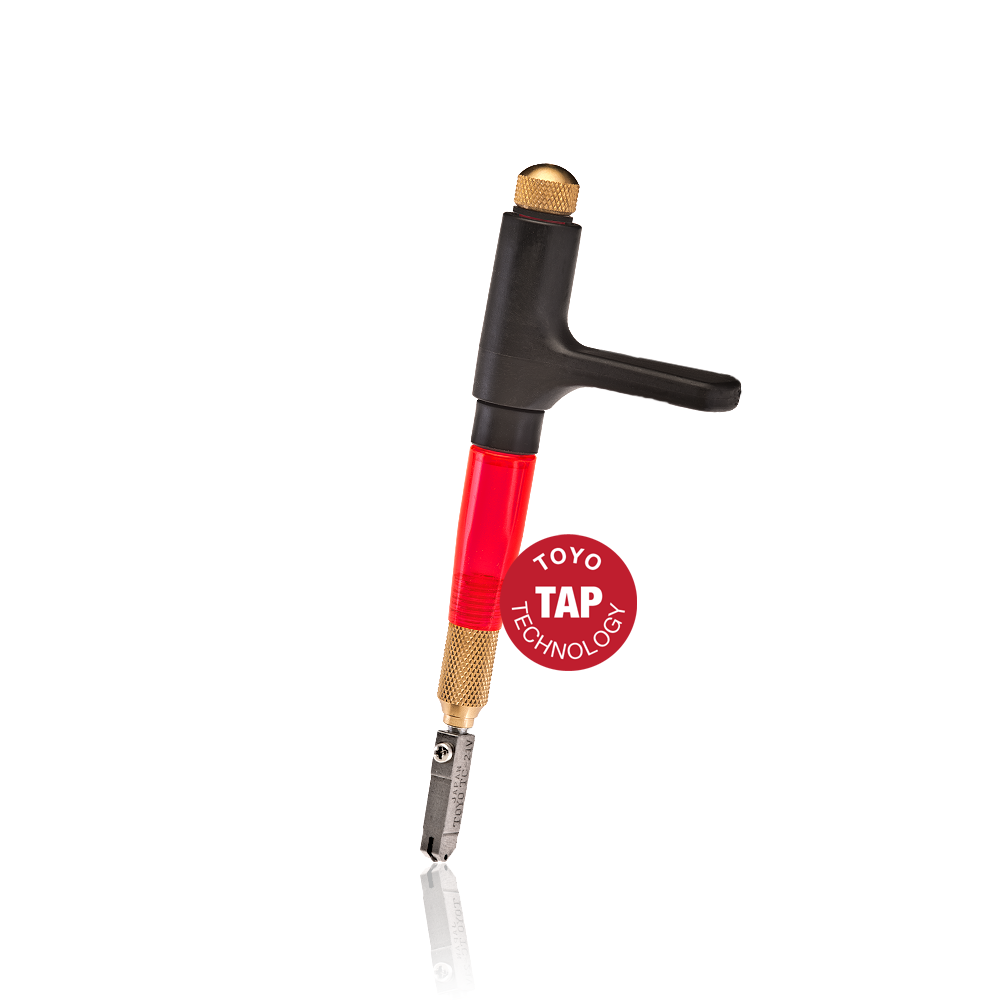
Adjustable saddle and oil-fed TAP Wheel for a broad range of art-glass shapes.
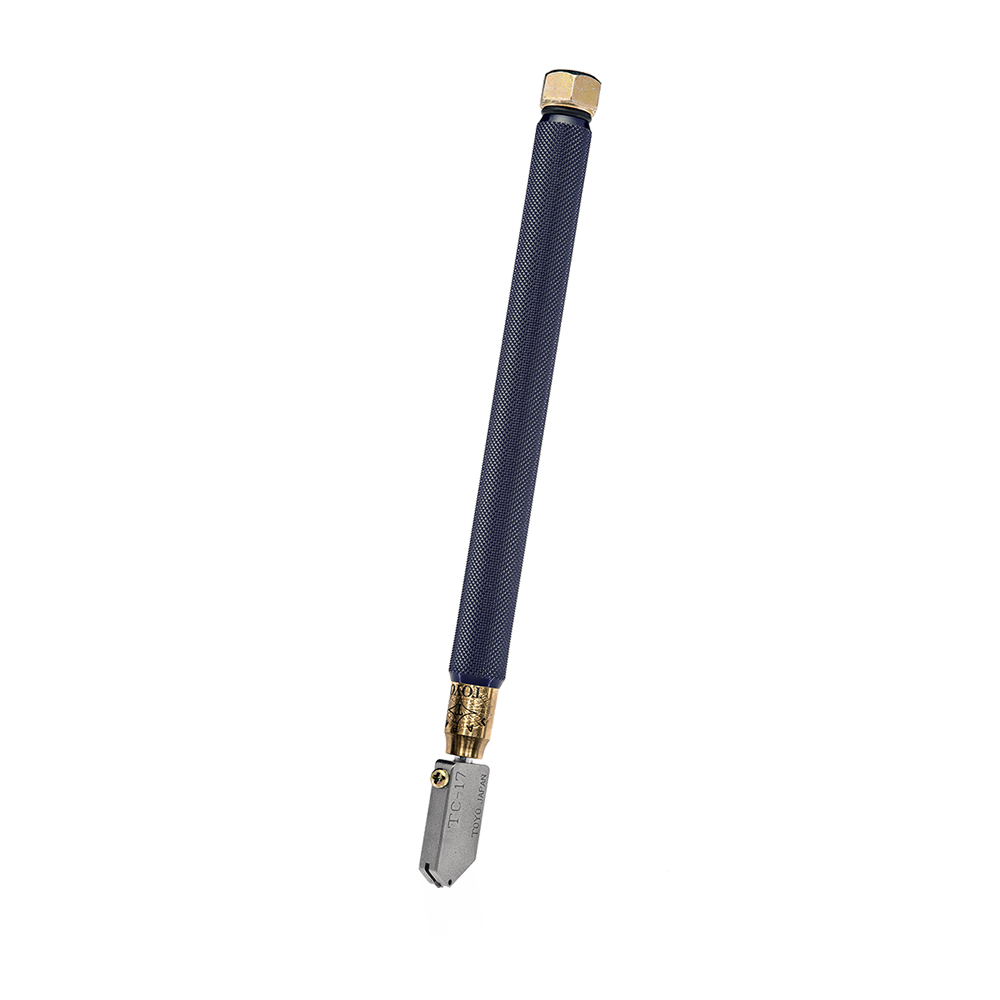
Brass pencil cutter with a straight head for guided sheet and mirror cuts.
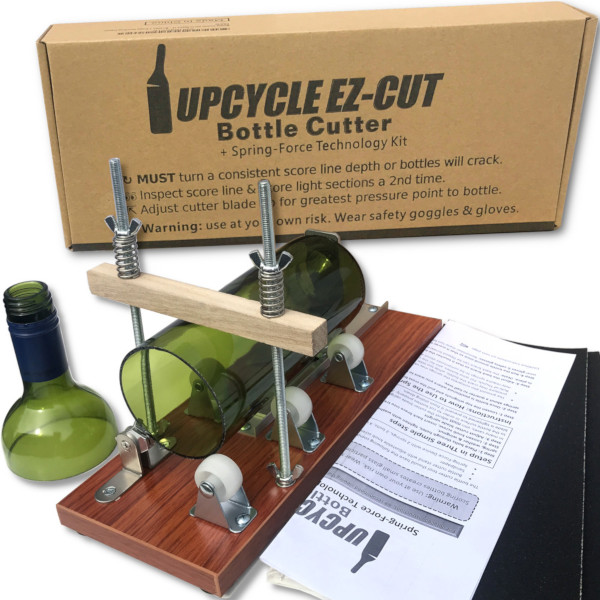
A supported, repeatable scoring path around bottles, with a spring attachment.
| Cutter | Type | Choose it for | Watch for |
|---|---|---|---|
| Toyo Custom-Grip Supercutter | Adjustable saddle; oil-fed wheel | Patterns and long sessions with a pencil-style grip | Uses its own replacement head; color varies |
| Toyo TC-600 Pistol Grip Glass Cutter | Oil-fed pistol handle | More leverage and a less pinched hand position | Assorted colors and head variants |
| Toyo TC17B Brass Pencil Supercutter | Straight-head brass pencil cutter | Ruler-guided window glass, mirror, and straight strips | Heavier and slimmer than contoured grips |
| Toyo TC1P Comfort Grip Glass Cutter | Contoured acrylic pattern cutter | Curves and small shapes without a pistol handle | Check pattern-head replacement compatibility |
| Studio Pro 653 Pistol Grip Glass Cutter | Self-oiling pistol cutter | A simple art-glass cutter with replaceable heads | Less model-specific head guidance than Toyo |
| IMT Pencil Style Oil Feed Glass Cutter | Straight pencil cutter with extra head | Occasional cutting with a replacement ready | Check the head fitted for your glass thickness |
| Upcycle EZ-Cut Spring-Force Bottle Cutter Kit | Bottle-scoring jig with spring attachment | Repeatable scores around beer or wine bottles | Separation and edge finishing are separate steps |
For flat stained glass, mirror, or ordinary annealed window glass, a hand-held wheel can score a planned line before you run the break. A bottle jig supports and rotates a cylinder to keep the score level around its circumference. The two categories solve different jobs. For detailed stained-glass shapes, see our stained-glass cutting guide; for tool and project matching, use the glass cutting tool finder.
A slim pencil cutter makes it easy to see the wheel and place it against a straightedge, but squeezing one tightly for a long session can tire the hand. A contoured or adjustable saddle spreads contact across the fingers. A pistol grip lets the hand remain more upright and can provide greater leverage. None is automatically more accurate: try a few scrap scores with the wheel upright and your wrist relaxed.
A pattern head suits freehand curves and small stained-glass pieces. A wider straight head is convenient for long guided cuts. Makers sell multiple head variants under similar family names; read the actual listing and replacement-head code, especially for Toyo’s TC-600 and Custom-Grip families. A spare head is useful only if it fits the cutter and the glass you expect to score.
Self-oiling means the handle stores and feeds cutting oil; it does not mean the tool never needs maintenance. Use a glass cutting fluid compatible with the cutter and follow the maker’s fill and storage directions. The cutter does not replace running pliers, breaker/grozer pliers, a straightedge, eye protection, a safe work surface, or an edge-finishing tool. A stained-glass grinder can refine an edge after the break; it cannot fix a badly placed score.
Key details: Four-position saddle · translucent oil reservoir · TAP Wheel cutting head · replacement head specific to the Custom-Grip.
If a conventional slim cutter forces you to pinch hard, the saddle on this Toyo gives your hand a place to rest between thumb and forefinger. Adjust its four positions until the wheel can follow the marked line without twisting your wrist. The oil reservoir is visible through the acrylic barrel, and the TAP Wheel design is intended to help initiate a clean, continuous score on art glass.
This is a good all-around choice for people who alternate gentle curves and straight edges. It still needs practice: a deeper-looking white score is usually a sign of too much pressure, not better cutting. The listing offers assorted colors, and the Custom-Grip head is not interchangeable with standard Toyo heads. Confirm the wheel/head configuration and replacement part before ordering.
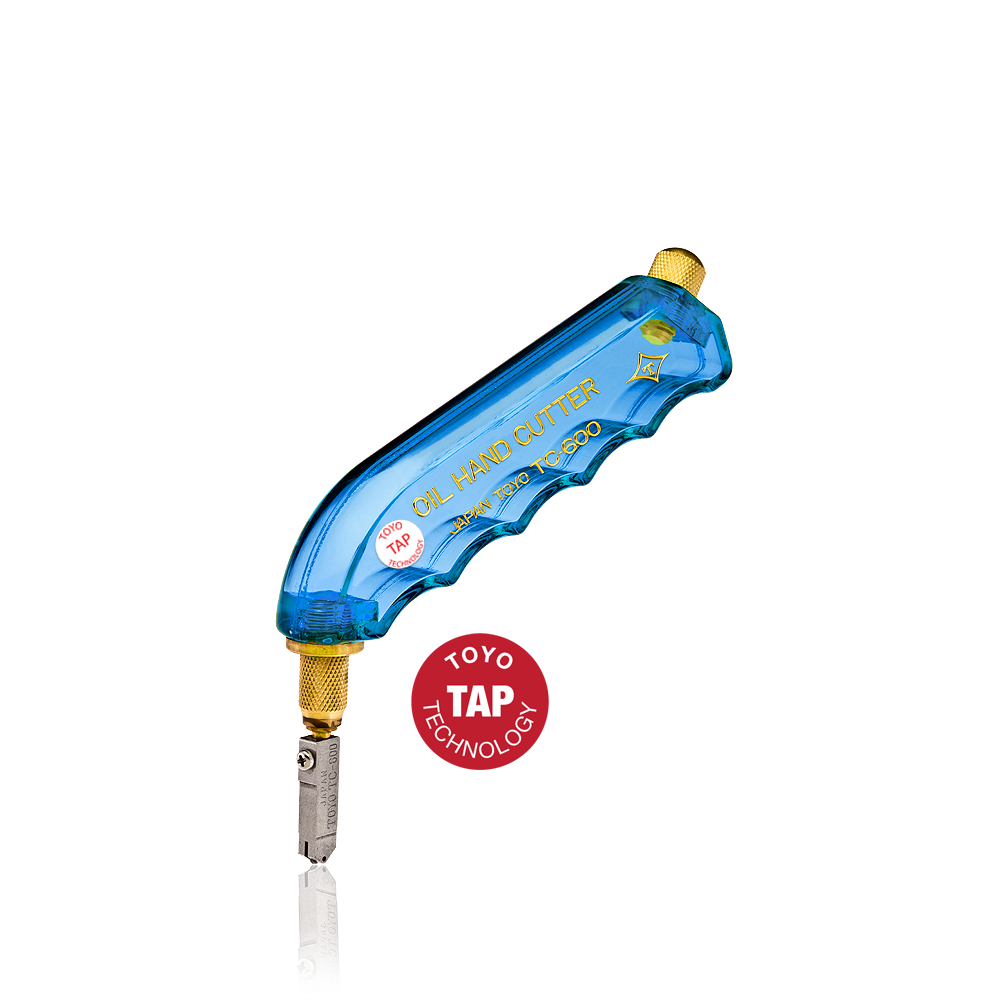
Key details: Pistol grip · handle oil reservoir · replaceable cutting head · linked listing identifies model TC-600.
The upright handle lets you press through the palm and forefinger instead of holding a narrow barrel like a pen. Many beginners find this easier to control on a flat work surface, and it can be a welcome alternative when prolonged pinching is uncomfortable. The reservoir feeds oil to the wheel as you score.
A pistol grip changes hand position; it does not make a score self-guiding. Practice on scraps to find the minimum steady pressure that leaves a fine line. Toyo sells pattern and straight-head variants in this family, while the linked Amazon listing calls it TC-600 and ships an assorted color. Inspect the current listing’s head style if you need a particular replacement wheel.
Key details: TC17B straight head · brass oil-reservoir handle · carbide cutting wheel · replaceable straight head.
The TC17B keeps a narrow, familiar pencil shape but gives it a durable brass body. Its straight head is the more natural partner for a square or straightedge on flat glass and repeated strip cutting. An oil feed lubricates the wheel, while the compact profile fits a small tool roll.
The brass weight and thin barrel will not suit every hand. For intricate stained-glass patterns or a grip that spreads load across your fingers, compare the Custom-Grip or TC-600. Use the actual wheel position to offset your guide; placing the ruler directly on the desired score line makes the finished piece too narrow.
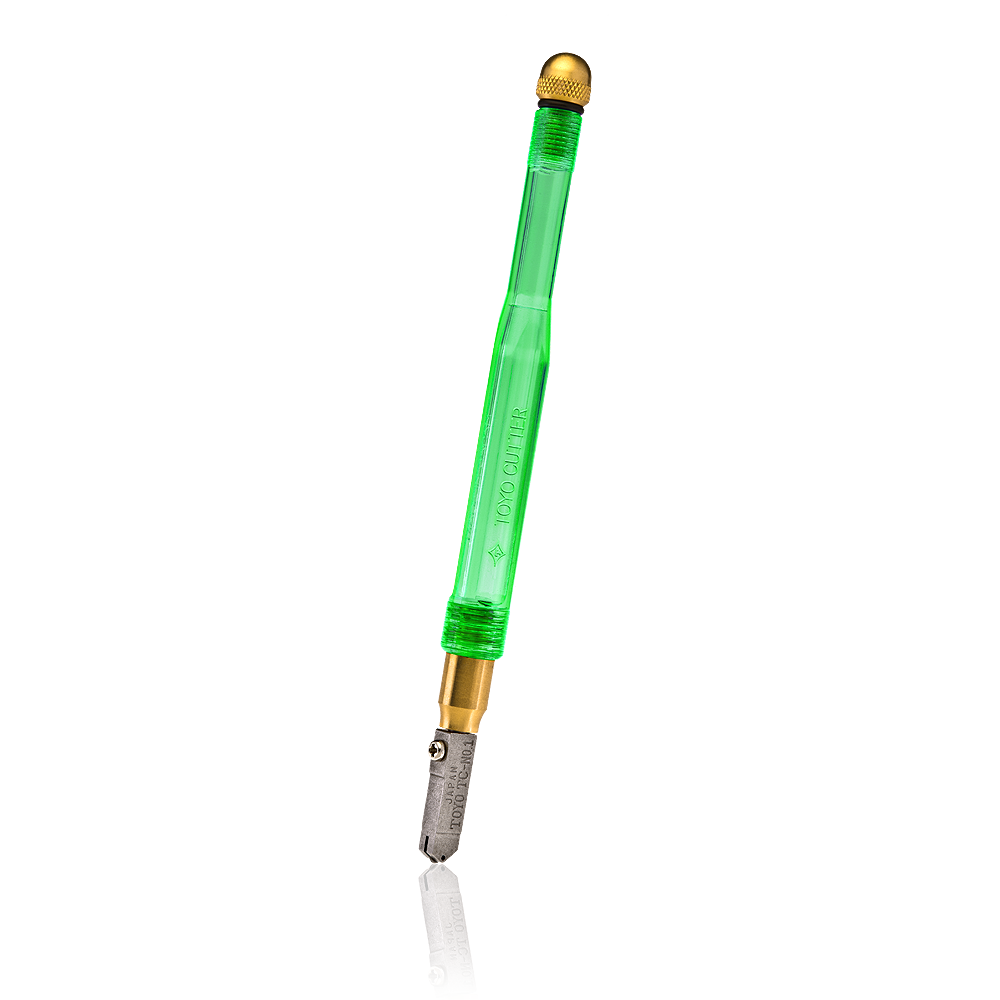
Key details: TC1P pattern-head version · contoured acrylic barrel · oil-fed wheel · lightweight pencil-style form.
The shaped acrylic barrel is a middle ground between the bare pencil profile of the TC17B and the more conspicuous saddle of the Custom-Grip. Its pattern head is intended for tracing curves in stained glass. The transparent body also makes it easier to notice when the oil reservoir needs attention.
Choose this if you like a conventional pen hold but want more contact area for the fingers. The contoured shape may feel awkward if you rotate the tool repeatedly during a complex pattern, so try the grip if possible. The linked TC1P is a pattern-head item; Toyo names the corresponding straight-head variant differently. Do not assume a replacement head listed for every Toyo cutter will fit it.
Key details: Diamond Tech item 653 · self-oiling carbide wheel · replaceable head · pistol-shaped handle.
Diamond Tech’s Studio Pro 653 takes the same broad ergonomic approach as the Toyo pistol grip: the hand rests on a taller handle, with the thumb near the head and fingers curled underneath. Its replaceable carbide cutting head and oil feed make it a practical starter for flat art-glass pieces.
The grip is the reason to buy it. If you already like a precise pencil hold, this shape may feel bulky near tight patterns. Follow Diamond Tech’s own cue for a fine, hairlike score; a gritty white line means you are bearing down too hard. Verify a compatible spare head and cutting oil when assembling a long-term kit.
Key details: Oil-feed barrel · tungsten-carbide wheel · extra replaceable head · listing states 2–12 mm glass range.
The IMT kit appeals when you want a pencil-style cutter with an extra head in the package. Its narrow form is straightforward to place beside a ruler, and the oil reservoir helps keep the wheel rolling. Treat the two heads as options to inspect, not a promise that either one is ideal for every sheet thickness or project.
The advertised thickness range is broad, but the wheel angle, glass type, and breaking method still matter. Most hobby stained glass is much thinner than the top of that range. If you want established head compatibility and a dedicated straight-cut tool, the TC17B is easier to specify; choose this for a lower-commitment kit with spare hardware.
Key details: Adjustable bottle jig · spring-force scoring attachment · sanding paper in the linked kit · suitable for round bottles within its adjustment range.
A hand pencil cutter is a poor substitute for a stable bottle jig. Upcycle’s rollers and back support hold a round bottle at one scoring height, while the spring attachment helps keep contact pressure steadier as you rotate it. This is the one to choose for bottle upcycling rather than flat stained-glass panels.
The jig only scores the bottle; it does not deliver a finished drinking rim. Follow the maker’s controlled separation instructions, work over a safe sink or tray, and smooth every sharp edge thoroughly. Bottle wall thickness and shape affect how cleanly a score runs, so expect some practice and possible rejects. The linked Amazon listing explicitly includes the spring-force kit; check those pieces before checkout.
| What you see | Likely cause | What to change |
|---|---|---|
| Wide, chalky score | Too much force or a wheel that is not rolling freely | Reduce pressure; check oil, cleanliness, and wheel condition on scrap |
| Score wanders from a ruler | Guide shifted or wheel offset was not measured | Secure a non-slip guide and mark the wheel path, not the body edge |
| Break runs away from a curve | Curve too tight, uneven support, or too much glass on one side | Plan relief cuts and use appropriate pliers; simplify the shape |
| Bottle cracks above or below the line | Uneven score, bottle variation, or abrupt separation | Check jig contact and follow the kit’s controlled heat and cooling method |
No. Tempered glass is made to resist the normal score-and-break method and can shatter into many pieces when damaged. Use glass that is appropriate for cutting before any tempering process.
It can make downward pressure feel more natural, especially if pinching a slim barrel is uncomfortable. A contoured pencil cutter can be just as suitable. Comfort and a consistent light score matter more than the handle label.
Use the lubricant recommended for your cutter. Oil-fed models need their reservoirs filled and their wheels kept clean. Do not substitute a random household liquid or assume the handle arrived filled.
Some cutters have specialized wheels for thicker annealed glass, but breaking a thick sheet requires suitable equipment and technique. Do not treat the broad thickness claim on a general-purpose listing as a guarantee. For thick stock, choose a cutter and breakout system specifically rated for its thickness and consider a professional glazier.
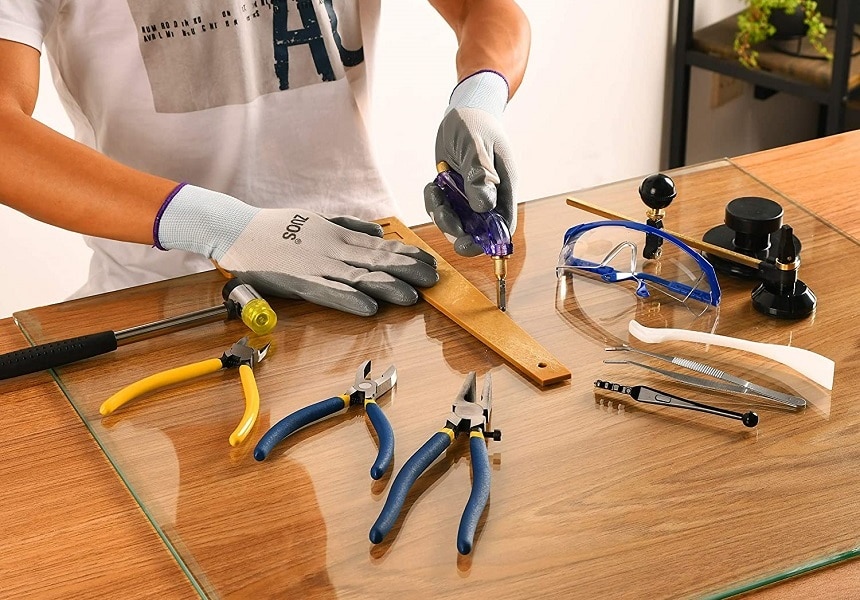
At minimum, add suitable glass, running and breaker/grozer pliers, a flat cutting surface, eye protection, and an edge-finishing plan. For a full copper-foil project, compare the stained-glass starter kits and a suitable stained-glass soldering iron.
The Toyo Custom-Grip is the versatile art-glass pick when a supportive grip matters. For an upright hand position choose the Toyo TC-600, and for a traditional straight-head cutter choose the TC17B. The Upcycle EZ-Cut is the distinct choice for round bottles. Match the head and breaking tools to your actual glass before buying.