

Whether you do heat transfers for yourself or as a business, you need a decent printer to get the job done. Unfortunately, not all printers can do this job as well as others. To help you find the best printer for heat transfers, we’ve done a lot of the research for you, picking the top ten models on the market for you to choose from.
For the models we’ve selected, we focused on a few key features. First, we looked at the printer technology since laser printing is faster while inkjet printers give you more detailed images for your heat transfers. We also made sure all of the models in our reviews have user-friendly controls to start right away. Most of them can also print wirelessly from your computer and devices and a few even have handy touchscreens to make them even more convenient. The best printer for heat transfers needs to have fast print speeds and great resolution, so we covered these areas as well. With these in mind, the Epson ET-2750 gets Our Editor’s Choice nomination. If you’re in the market for a new heat transfer printer, keep reading.
More features: no cartridges needed
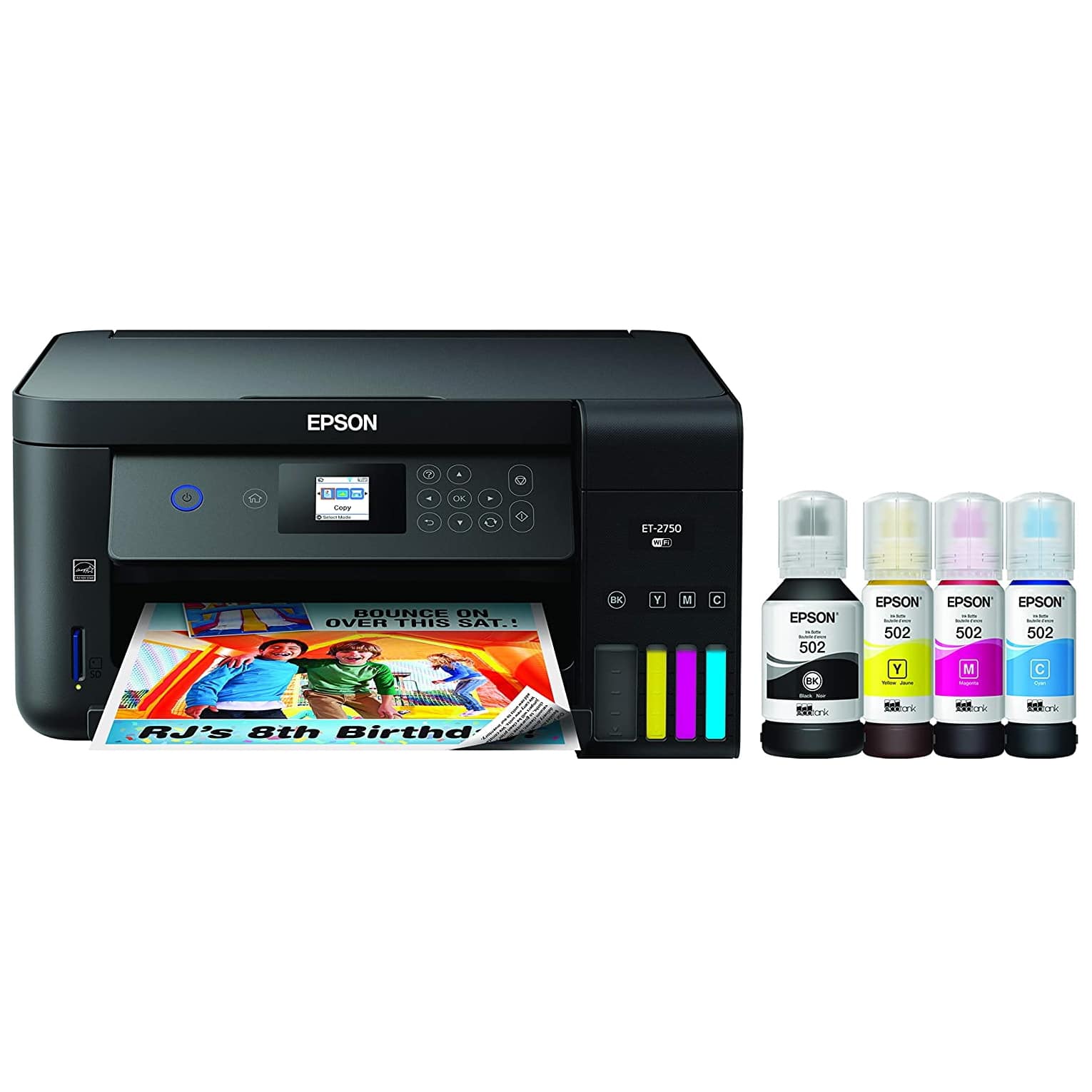
If you’re looking for an all-around remarkable model or specifically for the best Epson printer for heat transfers, the Epson ET-2750 may be the right model for you. It offers wireless printing from several devices, including iPhone, iPad, Android, smartphones, and tablets, plus it includes Wi-Fi Direct and voice activation using Alexa. This makes it easy to print whatever you like from anywhere in your home or office without tripping over cords.
This model comes with a 1.44-inch color display, which is a bit small, but the control panel it sits on flips up for easy use. The ET-2750 also includes automatic two-sided printing to help save on paper costs. The built-in memory card slot lets you print whatever you’ve saved and share some great 4 x 6-inch borderless photos with whoever you like.
The best feature this model boasts is the cartridge-free ink supply. Instead of cartridges, this model has supersized ink tanks for each color. You can refill these whenever needed using the large refill bottles, each of which includes an auto-stop to prevent leaking and spilling.
Included with the printer is a bottle of each of the black, cyan, magenta, and yellow ink, which is enough to print up to 6500 black pages and 5200 color pages. With regular use, this ink should last about 2 years before you need to buy new bottles. You also save money since the bottles cost much less than cartridges would for other units.
More features: optional second paper tray with a 550-sheet capacity
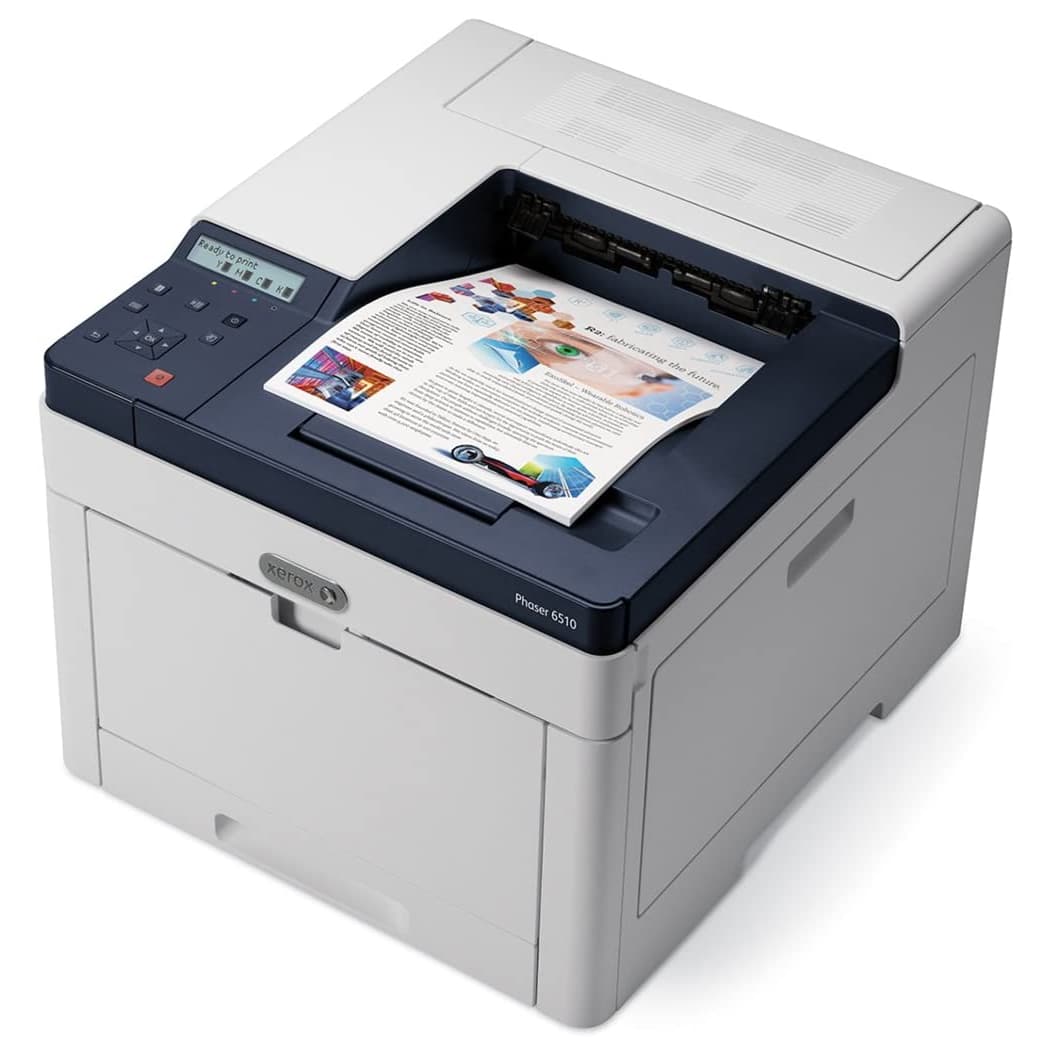
Despite its heavy weight of over 50 pounds, the Xerox Phaser 6510/DN is a great heat transfer printer for your small business, whether you’re working out of your home or going into an office. It prints up to 30 pages per minute, with a print resolution of 1200 x 2400 DPI for clear images and bright colors.
As well as heat transfers, you can use this product for a variety of cardstocks, envelopes, labels, recycled, and regular paper. The manual feed slot can hold 50 sheets, with another 250 sheets in the tray. There is also an optional second tray available if needed.
You can plug this model into your computer’s USB for your printed designs, plus it can be connected wirelessly to most smart devices, with a variety of support options available, including Apple AirPrint, Google Cloud Print, and a few others.
Other handy features include the LCD display for adjusting the printer settings, the Stay Secure technology to protect your documents, and standard automatic double-sided printing. The combination of the Pantone color-approved solid-color simulations and the color correction technology ensures that the design you print matches what’s on your screen.
The EA toner formulation for this unit has been upgraded to give you excellent resolution with less wasted toner, so you don’t have to buy it as often. It also melts at a lower temperature than other toners, saving some energy at the same time.
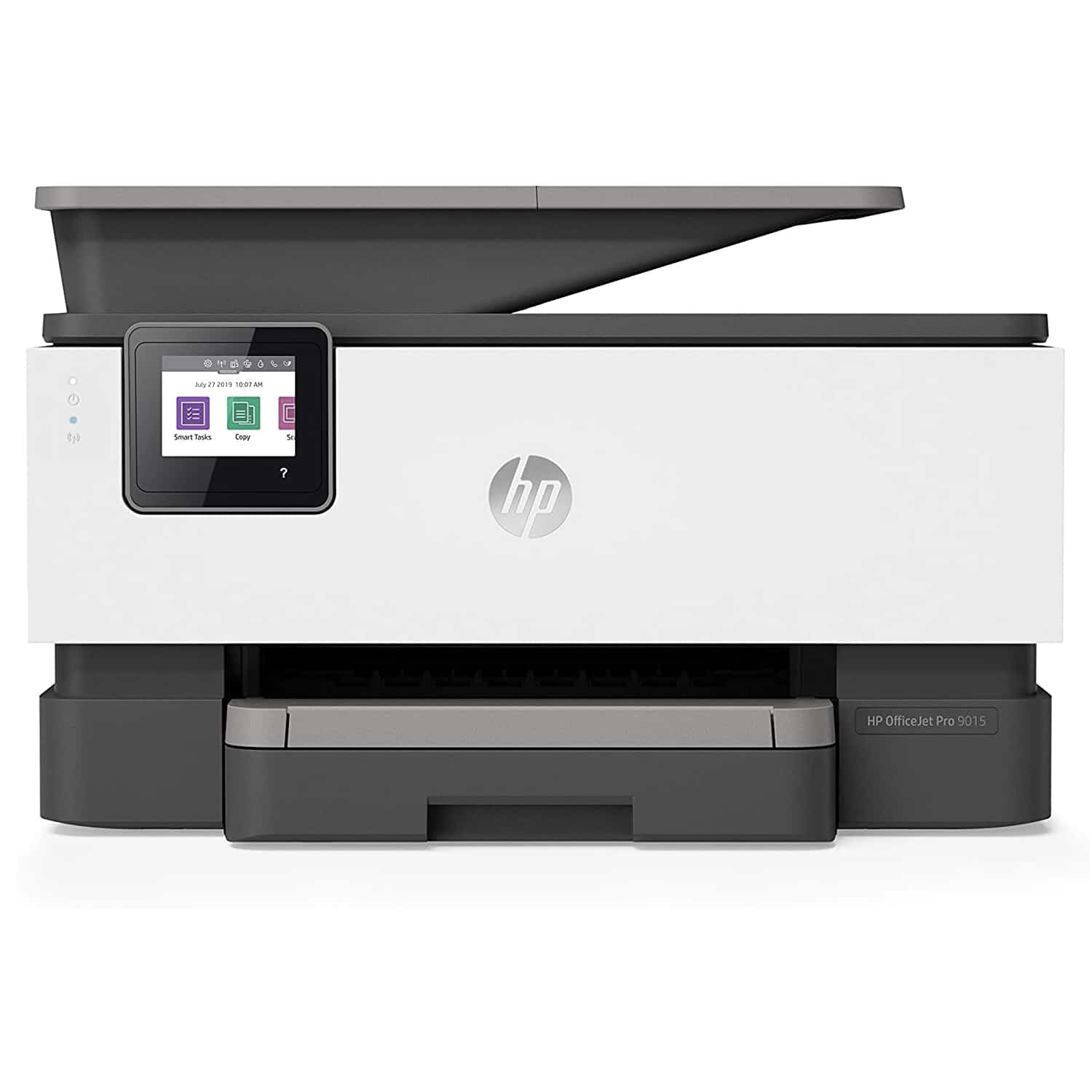
More features: copying and scanning capabilities; 2.6-inch color touchscreen panel
The best printer for heat press transfers should be easy to use with a variety of other materials as well, including regular paper, card stock, photos, and even envelopes. The HP OfficeJet Pro 9015 can handle all of these materials, plus it has a variety of other features that make it a great addition to any small office.
When it comes to printing, this model offers 22 ppm for black prints, plus it does great color ones as well, though this is a bit slower. It offers automatic two-sided printing, with a 35-page automatic document feeder and a 250-page paper drawer.
Of course, a great printer will do more than just printing. This model allows you to copy and scan all of your documents as well, with a handy HP Smart App that lets you access the printer from anywhere. You can print, scan, copy, check your ink levels, and so much more using this app on almost any device.
The Pro 9015 is easy to set up, linking to your home or office Wi-Fi router in no time. It also includes self-healing Wi-Fi, detecting any issues and automatically pursuing three different stages of reconnection to keep the unit up and running.
There is a color touchscreen on the unit as well, though it is a bit small at only 2.6 inches wide. Built-in security features protect your sensitive data from viruses and malware. You can also set up the HP Instant Ink plan for added convenience.
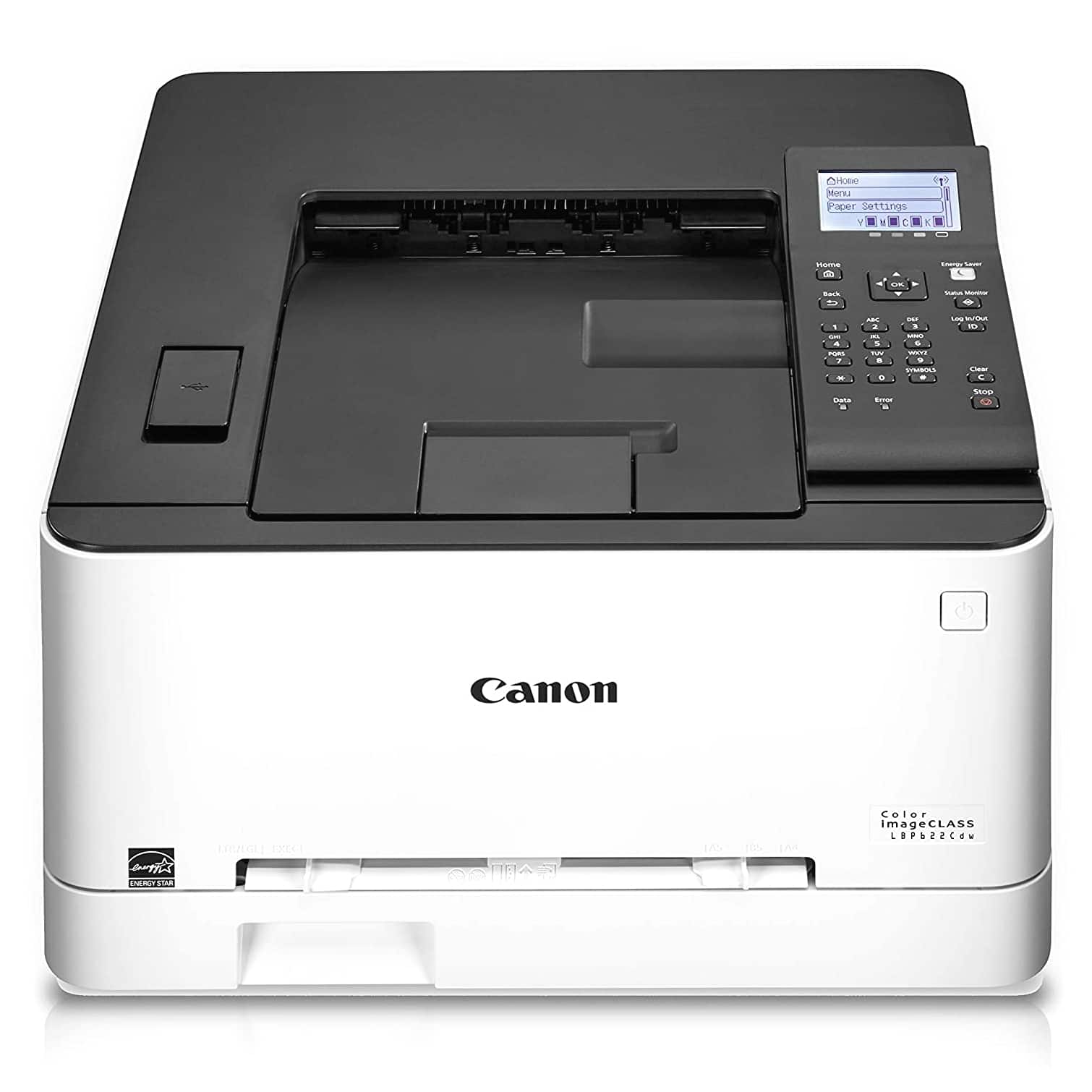
More features: wireless printing; 5-line LCD control panel
If you’re looking for the best laser printer for heat transfers without spending a fortune, the Canon Color Image CLASS LBP622Cdw is a good model to try out. It can be tricky to set up initially due to the unclear instructions, especially when it comes to the control panel. Some online resources can help you get it up and running, though.
Once you have the unit ready to go, it is quite handy for doing your heat transfers, as well as any other printing projects you have on your list. It is designed for smaller print jobs, so it is great for home use.
This model offers wireless connection to almost any of your smart devices, plus you can create a Wi-Fi Direct hotspot using the printer if you don’t have an external router. It is compatible with several mobile options, including Apple Air Print and Canon’s Print Business app. You can also connect it to your laptop for even more printing options.
This color laser printer for heat transfers uses a high-capacity all-in-one cartridge, which reduces the cost of printer supplies. It offers 600 x 600 DPI resolution and can print up to 22 pages per minute for those big jobs. You can even use it for two-sided printing if needed.
For the environmentally conscious, this model is Energy Star certified. It also combines fusing technologies and a low melting point toner for less power consumption.
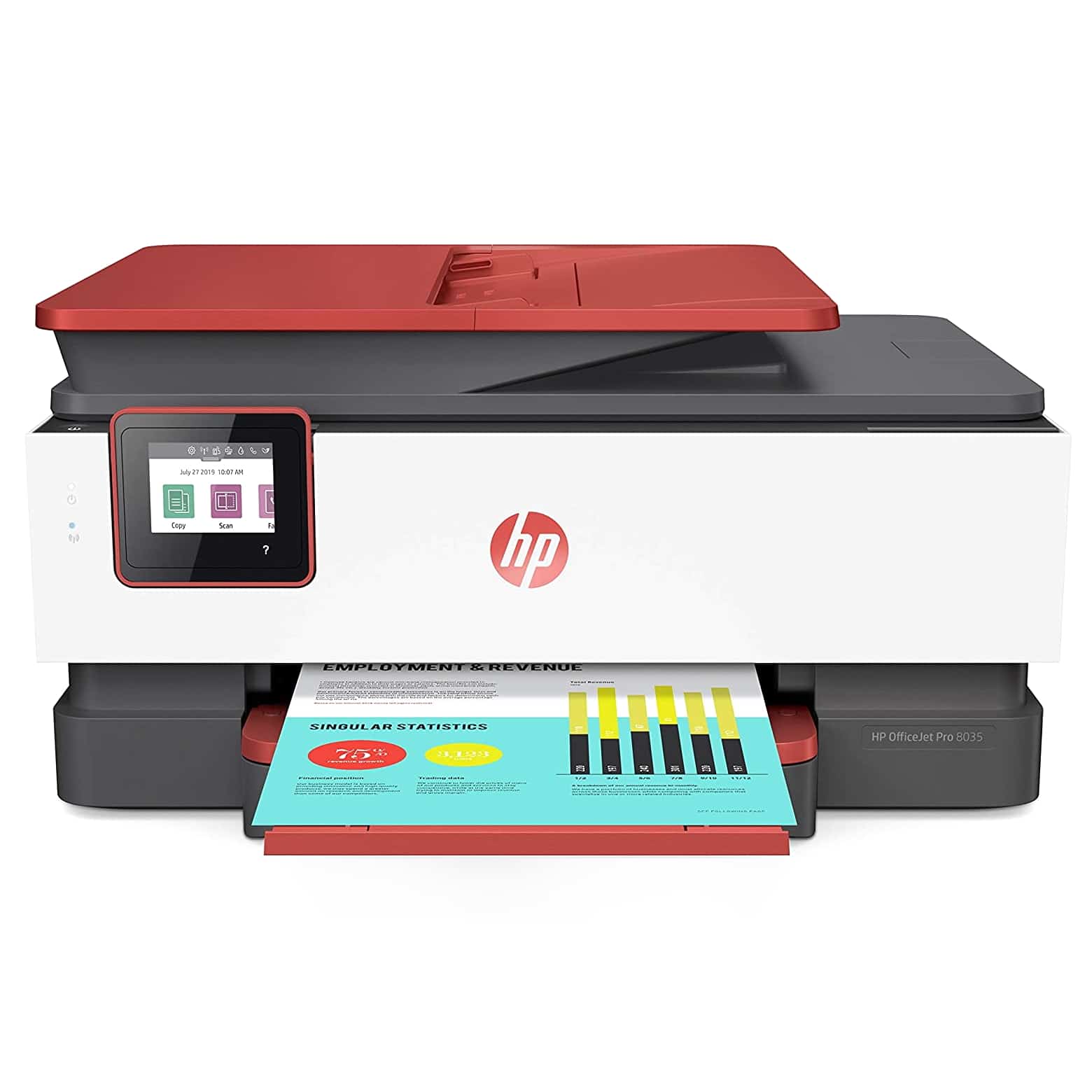
More features: scanning, copying, faxing functionality
Though the printing functions are the most important when looking for a new printer to use for heat transfers, how the unit looks is something you’ll notice right away. The HP OfficeJet Pro 8035 comes in three color options, including basalt, coral, and oasis, which adds some stylish accents to the unit. It is also made of recycled materials, so you will make a contribution when buying it, too.
This printer includes a variety of great features that make it even more worthwhile. As well as connecting it to your PC or laptop using a USB cord, this model can be used wirelessly as well, which allows you to link it to your smartphone or other devices. You can then download the HP smart app, which lets you print, copy, scan, and even monitor the printer’s ink levels quickly and easily. You can also use voice-activation with Alexa or Google Assistant.
The self-healing Wi-Fi troubleshoots connection issues automatically to ensure a reliable connection. There are also built-in security essentials, like password connection, document protection, Wi-Fi security, and basic encryption.
Other handy features include the automatic document feeder, the USB port for printing and scanning images, automatic two-sided printing, and the 20/10 ppm speed for black and color printing.
There is a touchscreen on the unit that allows you to select the function or customize the settings as needed. This screen is a bit small and hard to read unless the printer is at almost eye-level.
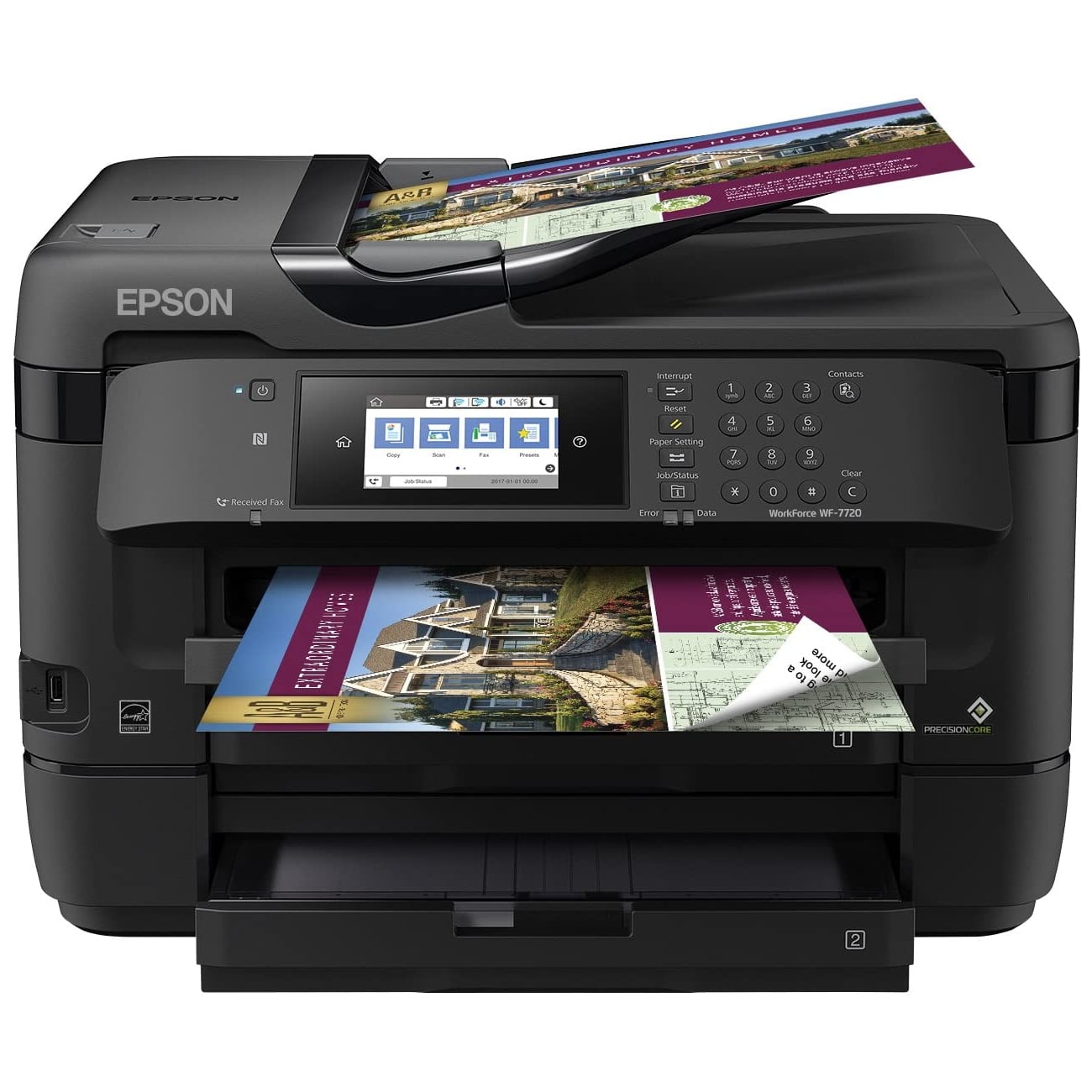
More features: prints up to 13 x 19 inches; 4.3-inch color touchscreen
If you need the best inkjet heat transfer printer with a user-friendly touchscreen, the Epson WorkForce WF-7720 is a great option. As well as the dual trays that give you a 500-sheet capacity, it includes a rear feed tray for specialty paper, like heat transfer paper, photo paper, or even larger sheets for bigger printing projects.
The Precision Core print head gives you great print quality, using smaller drops of ink to add more detail to all of your images. This print head can clog easily, though, especially if you aren’t printing regularly, which requires more frequent cleaning sessions.
As well as hooking up to your computer directly, this printer can be used for wireless printing using a smartphone or tablet. As well as printing, you can use this model for copying, scanning, and faxing, using the auto 2-sided option as needed.
The wide format lets you print materials up to 13 x 19 inches, so your heat transfers and other designs can go as big as you like. Scans can be as large as 11 x 17 inches as well.
On the front of the unit is the control panel, which includes a 4.3-inch color touchscreen that allows you to navigate the settings and alter the controls for each project.
This unit works best with Epson ink cartridges, which come in standard sizes as well as the XL sizes for high-volume printing. No matter which size you choose, you get the same quality results.
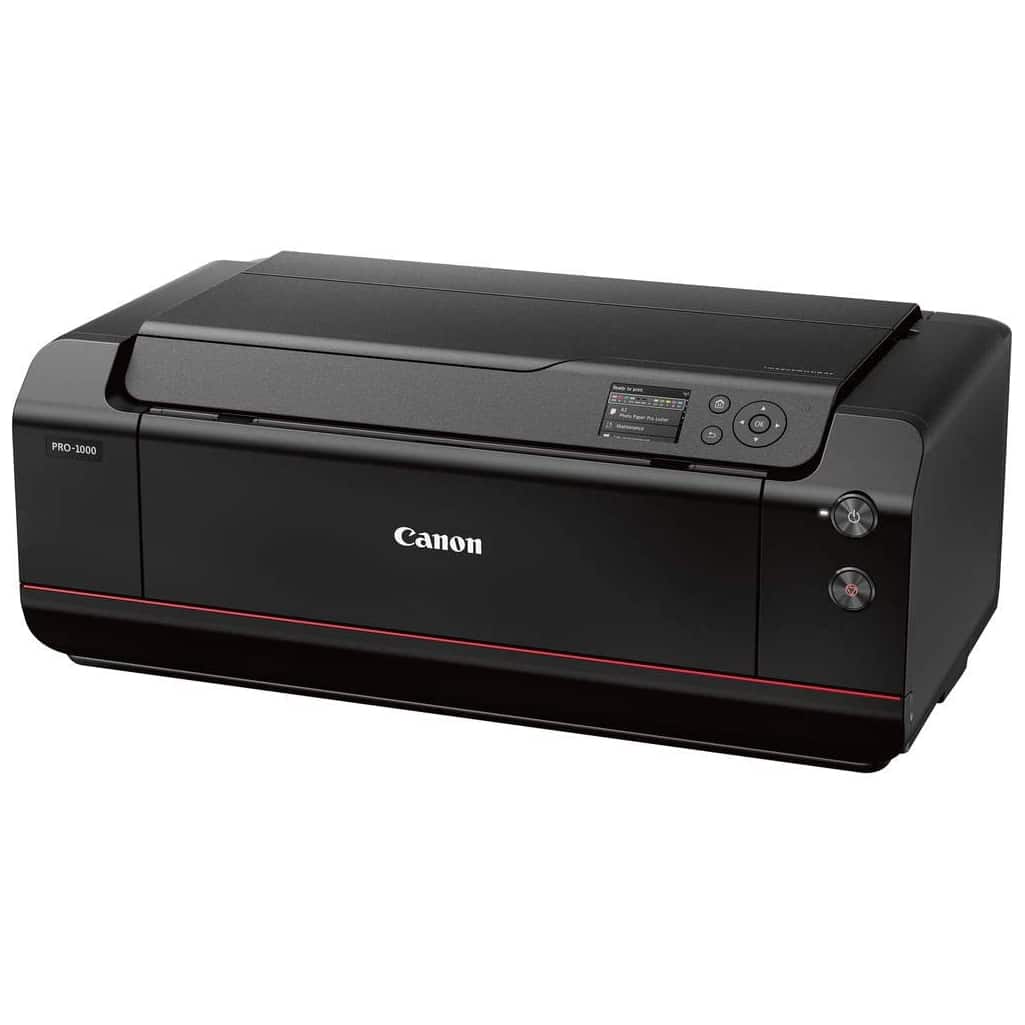
More features: 17-inch opening; uses 11 different inks
Though it is a rather pricey model, the print quality offered by the Canon imagePROGRAF PRO-1000 will make it well worth the cost, especially for heat transfers, graphic art, or photography. It includes some great features that give you vibrant colors and crisp dark areas to give your designs the professional look you’re going for.
This model uses the Lucia Pro Ink System, which uses denser droplet placement on the designs you’re recreating to give you a broader range of colors. This also improves your results, with better image clarity, vibrant colors, and enhanced darker areas for the perfect reproduction.
Another handy feature is the anti-clogging function. This uses a fine-print head combined with a tubular ink delivery system that allows this unit to print quickly without worrying about any ink clogs that could ruin your heat transfers or other printed documents. The 17-inch opening allows you to do large prints, as well as smaller ones.
The air feeding system keeps each page centered properly instead of allowing it to shift as the unit is printing for the proper ink placement on the paper, no matter what material you’re using.
This unit isn’t for infrequent use, though. It will clean the print head before each use and the longer you go between printings, the more ink it will waste during this process. A small office or busy home business won’t have this type of issue, especially if items are printed every day.
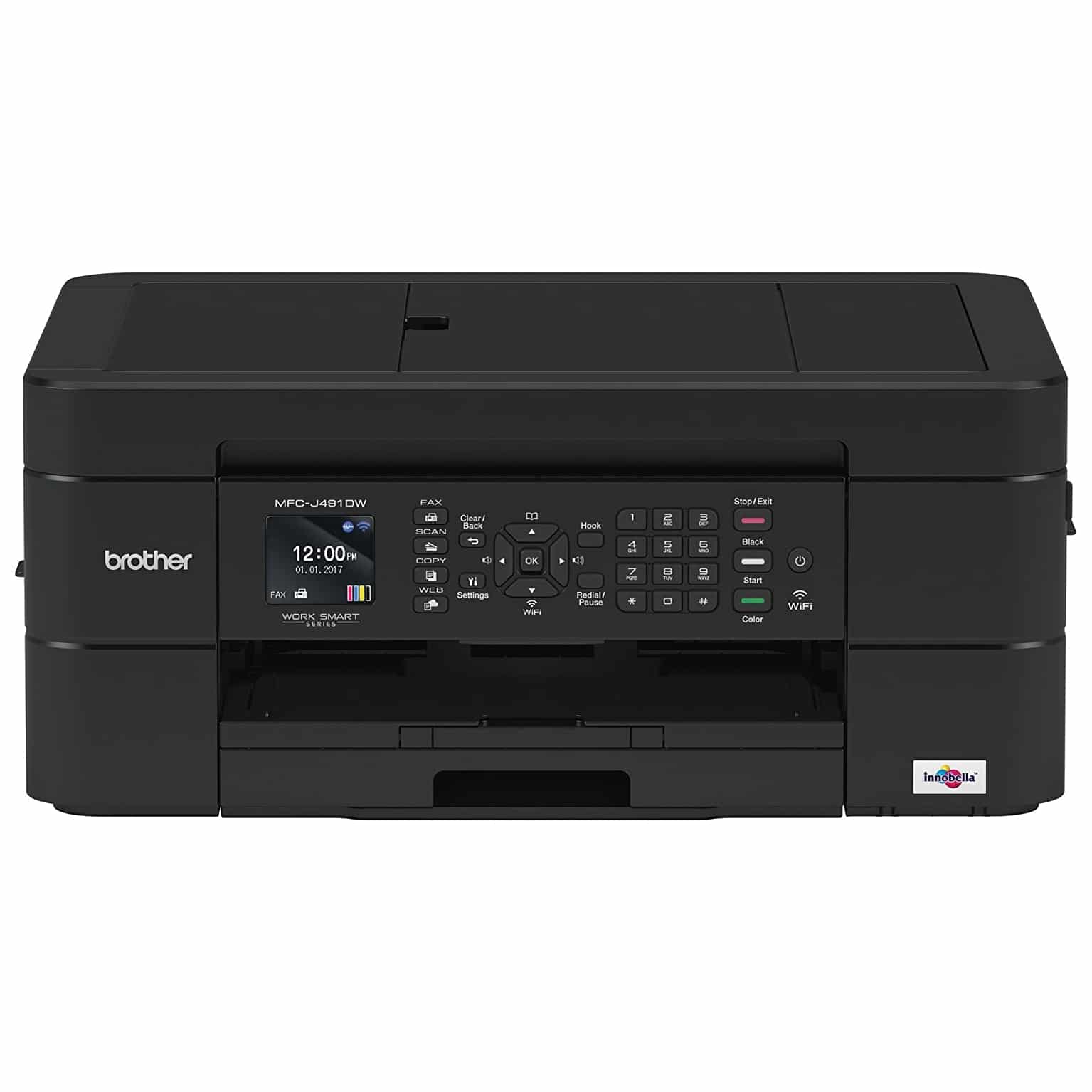
More features: 1.8-inch color touchscreen
Not only is this the smallest unit on our list, but it also comes with a great low price that will fit into any budget. It doesn’t skimp on the features, either, making this a great printer for transfer paper, photo paper, card stock, and envelopes. You can also use it for letter or legal-sized paper as needed.
The Brother MFC-J491DW can be connected locally to your home computer using the USB port but also has the option to easily connect wirelessly. This second option also allows you to work from your smartphone or tablet, as well as your PC or laptop, so you can send your designs and documents through all of these devices. You can even scan to the cloud to save your devices for future use.
Though there is no manual feed option, there is an adjustable paper tray that holds up to 100 sheets. You can use this inkjet printer for heat transfers, photo paper, card stock, envelopes, and so much more, making it quite versatile for all of your projects. It isn’t for heavy-duty use, though, due to the speed, which is a bit slower than some other models. It is a great option for home use to make your own custom heat transfer designs.
Other great features included with this printer are the automatic 2-sided printing, simple control panel, 1.8-inch touchscreen, scanner, fax, and the high-yield replacement ink cartridges.
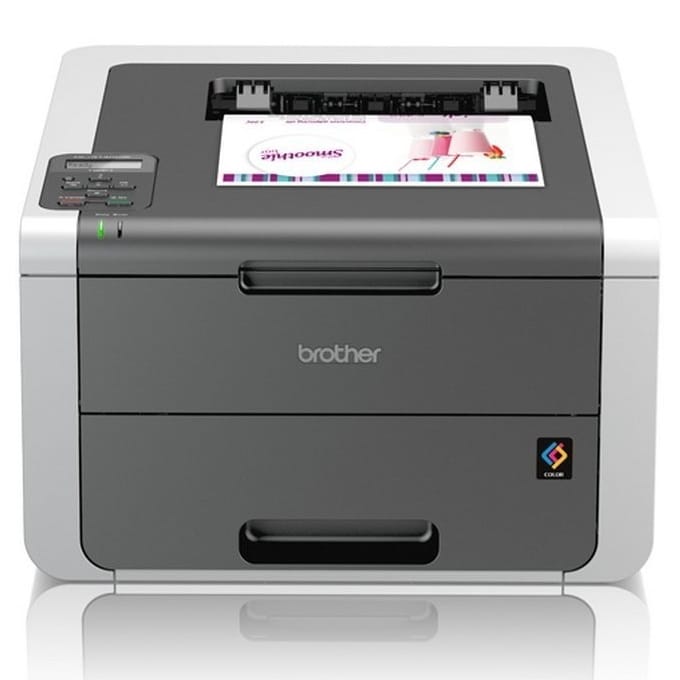
More features: Mobile Device Printing; 250-sheet capacity; single-sheet manual feed
Whether you’re doing your heat transfers at home or for a small business, the Brother HL3140CW is a great model to try out. The setup instructions are a bit confusing since they cover several models in one booklet but once you’ve deciphered them, this printer is easy to use, with a ton of great features.
This model is designed for heavy-duty use, with a top-loading toner compartment to switch it out quickly between printings. The toner is a bit pricey but you can buy off-brand toners to reduce costs.
It includes a 250-sheet paper tray, so you can print all the documents you need all at once without needing to refill the tray. The tray is adjustable, too, so you can set it as you need it. A single-sheet manual feed slot lets you work with thicker materials, like cardstock and envelopes.
Wireless setup is easy and allows you to print from a variety of devices using AirPrint, Wi-Fi Direct, Google Cloud Print, and the free Brother IPrint & Scan app. You can also connect it using a USB cable to your computer instead.
This printer offers 600 x 2400 DPI resolution to give you the vibrant colors you’re looking for in your heat transfers. It prints fast, too, putting up to 19 pages through the machine every minute.
Other handy features include the Deep Sleep Mode for reduced energy consumption, the auto-off mode, and the secure-function lock to limit accessibility on selected functions.
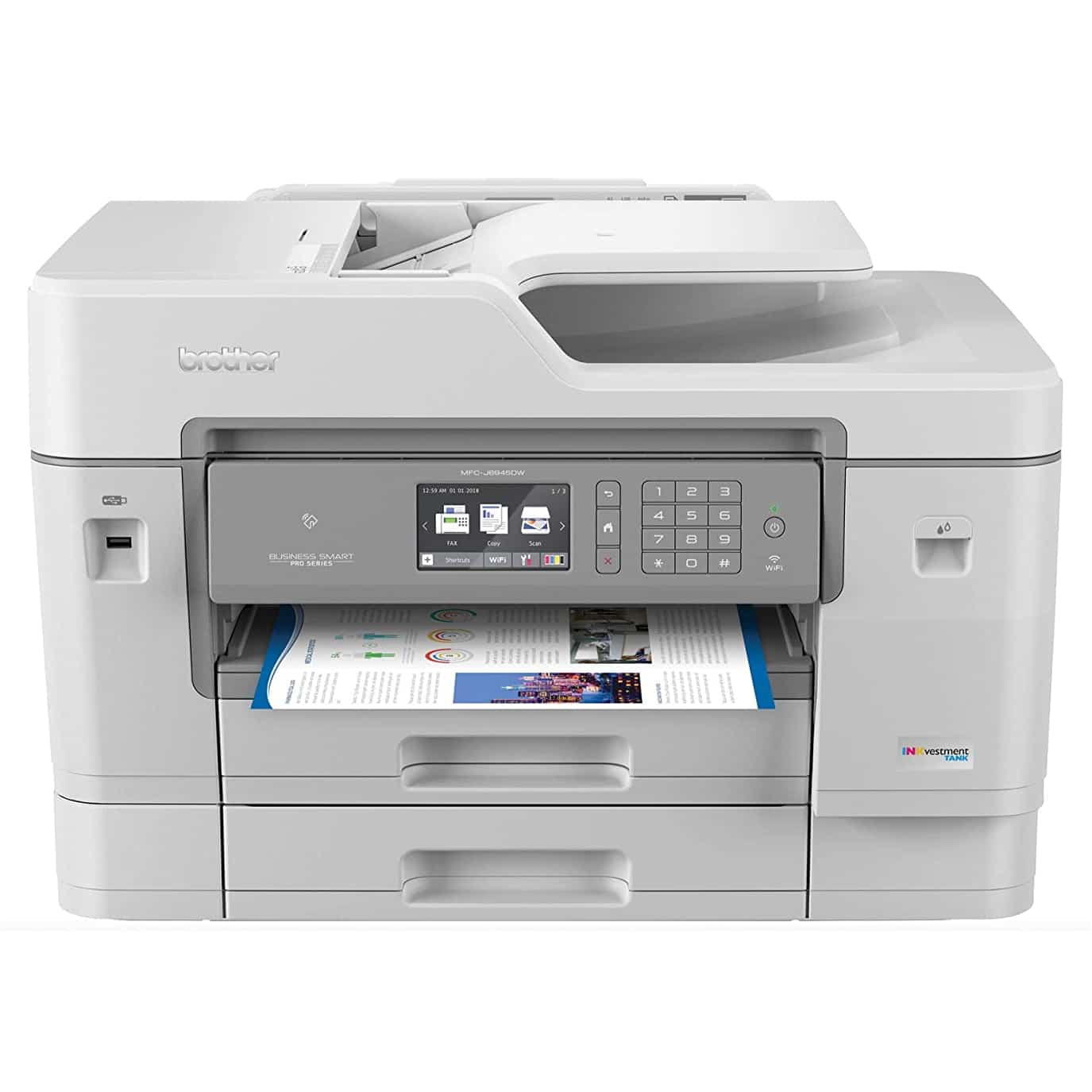
More features: 3.7-inch color touchscreen; wireless printing
The Brother MFC-J6945DW is a huge model for a small home office but for those with some extra space, it will make a great printer for heat transfers and other printing projects. You can link it to your computer using the USB port or connect wirelessly from a PC, laptop, smartphone, or tablet. It even allows you to use the NFC touch-to-connect for printing and scanning when you aren’t connected to a network.
This unit includes an intuitive cloud connection as well, so you can print items from cloud apps or scan them into it as needed using the 3.7-inch color touchscreen. It is compatible with OneNote, Evernote, Dropbox, Google Drive, and a few more, so you can use the ones you prefer for this.
As well as the printer, this model comes with enough ink to last about a year. These front-loading ink cartridges hold more ink than some other brands on the market, plus they work with the INKvestment Tank Ink System to print more pages without interruption. As well as the standard cartridges, you can choose the Super or Ultra High-Yield replacement cartridges to get more ink for less money.
Another handy feature is the Page Gauge, which displays the amount of ink left in the cartridge with the normal gauge levels for each color, as well as an approximate page amount left for each one, so you never have to guess when it will be empty.
When you have the perfect design chosen that you want to add to your clothing, bags, or even a mug, you need the right printer to create a quality heat transfer. Of course, there are many printers capable of this task, as well as printing your other projects and documents for added convenience. If you’re in the market for one of these models, the following sections can help you get started.
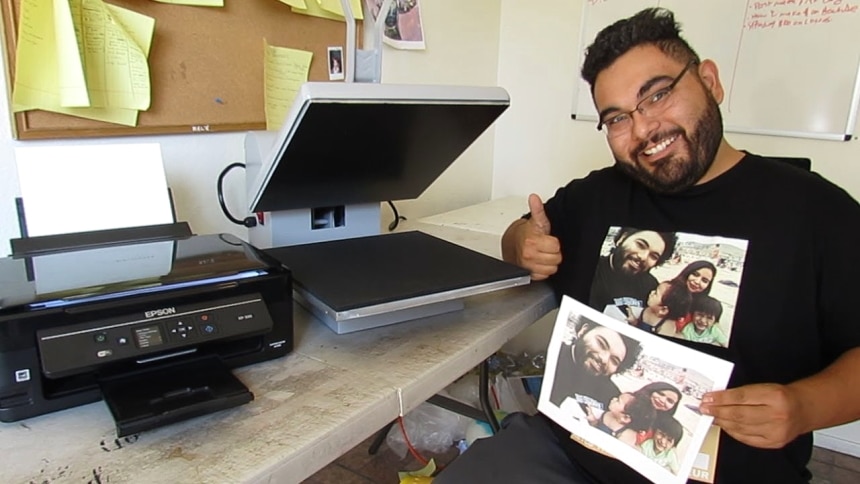
Though you may want to use your regular home printer to make your heat transfers, this isn’t a good idea. They don’t give you the quality results you need for a lasting design. Of course, you can use the machine you do heat transfers with for other items, so if heat transfers are your main focus, buy a printer that does this well, and then check out the features for the other uses.
Once you have the perfect heat transfer printer ready to go, it’s time to get started on your heat transfers. It is easier than you may think. As well as the printer, you also need the right heat transfer paper. There are options for laser printers and inkjet printers, so be sure to match the paper to the machine you’re using for the best results.
Choose your design. Use editing software to adjust the size of the image or alter it however you like. When it’s ready to go, it’s time to start printing. This can be done the same way you print any of your other documents. Place the transfer paper in the manual feed slot, or the drawer if no manual feed slot is available, and start printing. Color prints take longer than black prints, especially if there is a lot of detail to be covered. Unlike a regular document, it takes longer for the ink to dry on heat transfer paper, so let it sit in the outbound tray for a few minutes to prevent smudging. Then you can transfer the design onto a bag, t-shirt, or whatever else you like.
There are a lot of features to look for in a new printer for heat transfer paper, which can be confusing if you’re not sure what to look for. The following sections cover the most important ones.
In our reviews, we’ve focused on two main types of printer technology for heat transfers, inkjet and laser. Though they both can be used for heat transfers, they are not equal in how they perform or the results you get for the finished product.
Inkjet printers, like the Brother MFC-J6945DW, are quite common and usually a bit cheaper than the laser printers on the market. They use either dye-based, sublimation-based, or pigment-based inks. Dye-based inks are the cheapest option for a reason. They tend to fade and bleed after printing, so they aren’t the best choice for lasting heat transfers.
Sublimation-based inks are more lasting, though they are a bit trickier to use, requiring some extra knowledge and effort on how to print the transfers and the proper fabric to use them with.
Pigment-based inks are the best options since they offer some water protection when washing or in humid conditions. They also don’t bleed for better-looking transfers. The downside is that this ink is more expensive than the other two options.
The Xerox Phaser 6510/DN and other laser printers are a more obvious choice when it comes to heat transfers since these models use heat to burn the ink onto the paper, similar to the way a heat press machine would do. They do tend to jam more often, plus there is also the risk of overheating, which can damage the transfer paper and the printer itself. They use toner cartridges instead of ink for their printing purposes.
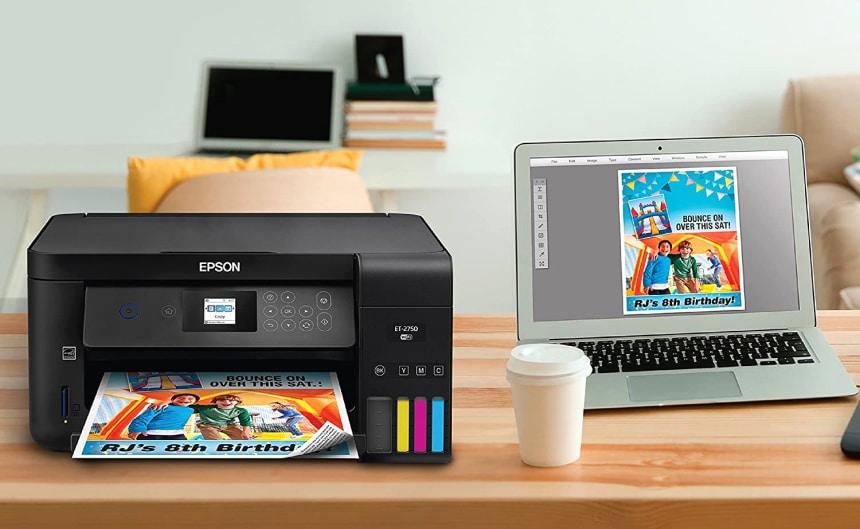
The maximum resolution is another important feature since good resolution means a more detailed finished design. The resolution is listed as the DPI, which stands for dots per inch. The higher the printer’s DPI is, the more detailed and vibrant the picture quality will be. The average resolution is different for inkjet and laser printers.
Inkjet printers usually print at about 600 x 600 DPI, which gives you decent resolution on your images. Of course, many models go much higher than this. For instance, the Epson ET-2750 has a resolution of 5760 x 1440 DPI, which is extremely high. The results are vibrant colors and crisp lines for amazing heat transfers.
Laser printers tend to have higher average resolutions than the inkjet models at about 1200 x 1200 DPI. This doesn’t mean that a lower resolution is bad. The Canon Color Image CLASS LBP622Cdw has the lowest resolution in our reviews at 600 x 600 DPI but still delivers quality results. Higher DPI ratings are better, though, for those quality images that you’re looking for in the best heat transfer.
The maximum print speed tells you how much paper the printer can print out in a short amount of time. It is measured in ppm, or prints per minute. The higher the ppm, the more documents the unit can print every minute.
The highest ppm in the models that we’ve reviewed is the 30 ppm offered by the Xerox Phaser 6510/DN. This means that this model can print up to 30 documents every minute, which is great for those people printing large amounts since the items will be printed quickly. For offices preparing documents for a meeting, this speed is essential.
Of course, this doesn’t mean that all of your documents will print at this speed. Simple black and white copies will still print quickly but items with colored graphics will need some extra time. The same goes for any colored documents or photographs. Color prints take a bit longer due to the extra detail needed. For this reason, many models display the ppm for both black and colored documents separately. The Brother MFC-J491DW is one of these, offering 12 ppm for black prints and 6 ppm for colored ones.
The tray capacity is another important feature to look for in a new heat transfer printer. These trays are much larger than they used to be, holding a ton of paper to keep you from refilling it every few minutes. Smaller models can handle about 100 sheets of paper, while larger models, like the Brother HL3140CW, include a drawer that can hold 250 sheets. The larger the drawer, the less often you’ll run out of paper during your big printing projects.
Some models also have other trays. There could be a manual feed tray on the top of the machine that lets you put in a sheet at a time, which is best for those extra materials like cardstock, envelopes, or even heat transfer paper. There could also be a separate tray on the machine that can hold a smaller stack of these specialty materials, so you don’t have to stand there and insert each of the pages manually, making your job a bit easier.
Every single one of the printers in our reviews come with the ink or cartridges needed to get you started. Unfortunately, they aren’t always the standard sizes. This means that there is less ink in the cartridge than there would be if you bought them separately. Not only does this give you less ink to work with, but it also means you waste a lot of it setting up the printer. There are always test pages that need to be printed, using up a lot of the ink that is supplied with the printer when you purchase it. For this reason, many people buy ink along with the printer to ensure they have enough to last more than a few days.
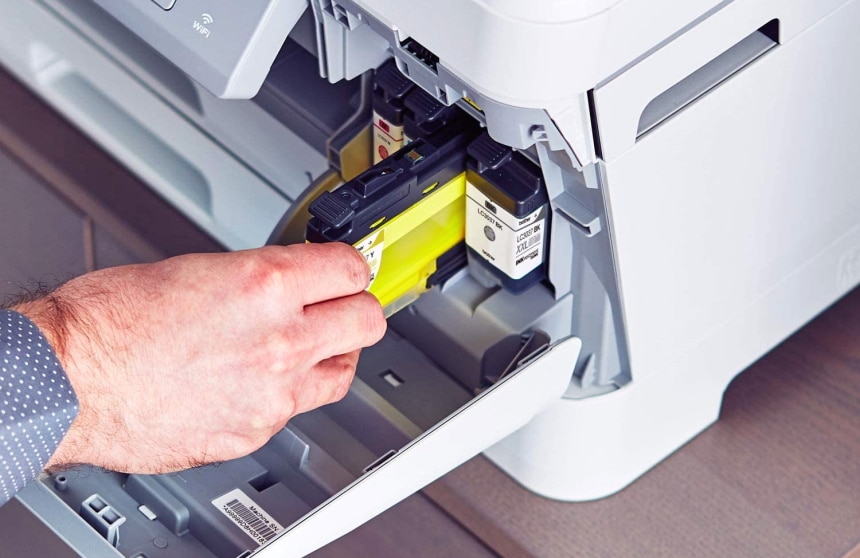
Of course, this isn’t always the case. The Epson ET-2750 includes enough ink to last about two years with the printer. It includes all four colors that go into the machine, including a large supply of black and smaller bottles each of the cyan, magenta, and yellow. You can literally print thousands of pages with this amount of ink, making this a great purchase since ink and cartridge refills can be a bit pricey.
All of the printers that we’ve reviewed here have some sort of control panel. Some of these are quite simple to use, while others have a few more buttons to deal with. Those extra buttons can be confusing at first but once you get to know your printer, you should have no trouble manually choosing the settings and functions you need. The layout should be functional and easy to master, with everything clearly labeled to make using it easier.
Some models also include touchscreen displays, which you can use to customize the settings and choose the function you need. This screen should be at least a couple of inches wide to make it easy to touch the setting you want without accidentally pressing the wrong thing. Larger screens are also easier to read, especially for those whose vision isn’t what it used to be.
If you’re only printing from a PC and you have the space to put the printer almost right next to it, linking the two using a USB cable isn’t an issue. Of course, the modern age has given us a wide variety of mediums to print from, requiring wireless use to get the same job done. This means that we can use a laptop, smartphone, or tablet to create our heat transfer designs and other documents and then send them to the printer wirelessly using a Wi-Fi connection.
Not only does this allow us to print from anywhere we are, even in a separate room, it also means that there are fewer cables and cords to deal with. You don’t even have to get up to print the item you want, plus your office looks much cleaner without all of those wires stretched everywhere.
The dimensions of any printer need to fit in the space you have available. For those in a small home office, a huge printer may take up too much room, leaving you little for the rest of your essentials. Larger offices or small businesses may have a bit more room to work with, so the dimensions may not be that much of an issue. Be sure to measure the space you have allotted for the printer and buy one that fits in, without sacrificing the features you need.
The weight isn’t quite as important unless you plan on moving your printer around the room regularly. As long as you can get it where it needs to be and the desk or table can support the weight of it, how heavy it is may not be an issue.
The warranty on every product you buy is important because it protects you from paying for costly repairs or replacements if there is an issue with the product you buy. Printers for heat transfers are no different. The majority of the models in our reviews have a 1-year limited warranty. The Epson ET-2750 offers a 2-year limited warranty with the registration of the printer. The Epson WorkForce WF-7720 has the best warranty of them all at 3 years, giving you extra time to test out the unit to be sure it’s working as it’s supposed to.
The best heat transfer printer will create amazing designs that you’ll be proud to show off. Of course, some printer models have a bit more to offer than others.
Our favorite model is the Epson ET-2750. This inkjet printer features a 5760 x 1440 DPI, a flip-up control panel, a built-in memory card slot, and automatic two-sided printing. This model is also wireless, allowing connections to your computer and devices, as well as Wi-Fi Direct and voice-activation through Alexa.
The Xerox Phaser 6510/DN laser printer is wireless, with a 30 ppm speed, an LCD display, Stay Secure technology, automatic two-sided printing, Pantone color simulations, color correction technology, and an upgraded EA toner formulation. It also includes a 50-page manual feed slot and a 250 sheet tray.
The HP OfficeJet Pro 9015 is one of the best printers for heat transfers. It offers 22 ppm for black prints, plus it does great color ones as well, though this is a bit slower. It offers automatic two-sided printing, with a 35-page automatic document feeder and a 250-page paper drawer.