

As an Amazon Associate I earn from qualifying purchases.
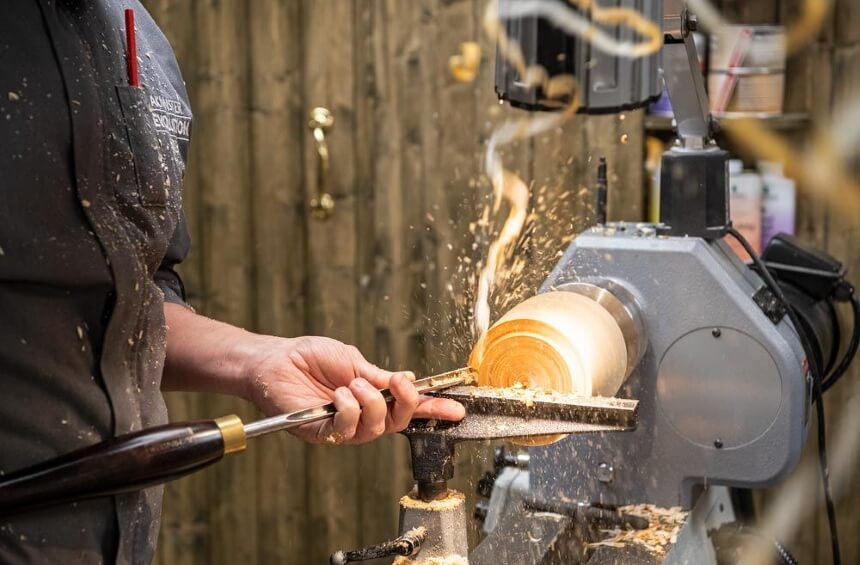
A mini wood lathe should fit your projects as well as your bench. An 8-inch lathe is a sensible starting point for pens and small ornaments; a cast-iron 10-inch machine gives you more room and steadier support. For dollhouse pieces and model-making, a micro lathe is an entirely different tool. These five picks cover those jobs without treating every machine labeled “mini” as interchangeable.

10-inch swing, 18 inches between centers, cast-iron build, and five belt-selected speeds.
8-by-13-inch capacity, dial-controlled speed, and a simple setup for small work.

A 1 HP motor, low-speed range starting at 250 RPM, and a substantial 95-pound build.
| Machine | Best for | Swing × between centers | Motor and speed | Accessory fit |
|---|---|---|---|---|
| RIKON 70-105 | General small turning | 10 × 18 in. | ½ HP; five fixed speeds, 500–3,200 RPM | MT2; 1 in. × 8 TPI spindle |
| WEN LA3421 | Pens and limited bench space | 8 × 13 in. | 3.2 A; variable 750–3,200 RPM | MT1 taper |
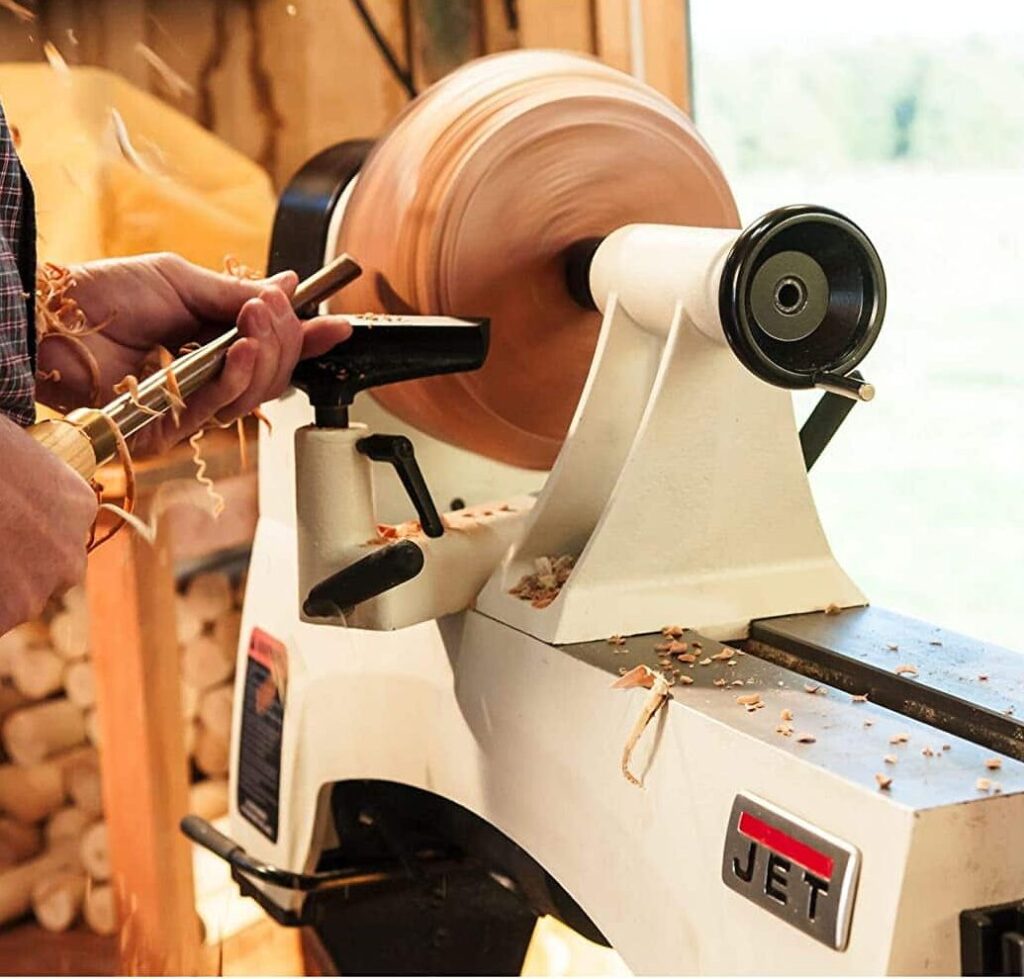
| JET JWL-1015VS | Easy speed changes | 10 × 15½ in. | ½ HP; three variable ranges, 200–3,600 RPM overall | MT2; 1 in. × 8 TPI spindle |
| Laguna Revo 10|14 | Higher-power compact turning | 10 × 14 in. | 1 HP; three variable ranges, 250–3,200 RPM overall | MT2; 1 in. × 8 TPI spindle |
| PROXXON DB 250 | Dollhouse and model-scale work | 1⅗ × 10 in. | 100 W; variable 1,000–5,000 RPM | Proxxon collet/chuck system |
Swing is the largest theoretical diameter that clears the bed, not a promise that every blank of that diameter can be turned safely. Between centers is the nominal spindle length before chucks, centers, and workholding use part of that space.
At a glance: 10-inch swing · 18 inches between centers · ½ HP · five pulley speeds · 75 lb · MT2 spindle and tailstock tapers.
The 70-105 is the easiest all-round recommendation if you want a conventional woodturning machine for pens, small handles, ornaments, and modest faceplate work. The cast-iron construction and 75-pound weight give it a more planted feel than a tiny lightweight lathe, while its 18-inch between-centers capacity leaves room for longer spindle projects. RIKON designed this model with pen turners in mind and uses common MT2 tapers and a 1-inch by 8-TPI spindle nose.
Its five speeds are selected by moving the belt: 500, 1,175, 1,850, 2,225, and 3,200 RPM. That is straightforward but less convenient than turning a speed dial, especially when you frequently switch between drilling, shaping, and finishing. The 500-RPM bottom speed is also higher than the low range on the JET and Laguna; use extra caution with uneven blanks, and move to a larger lathe for bigger bowls.
Model details: RIKON 70-105 specifications.
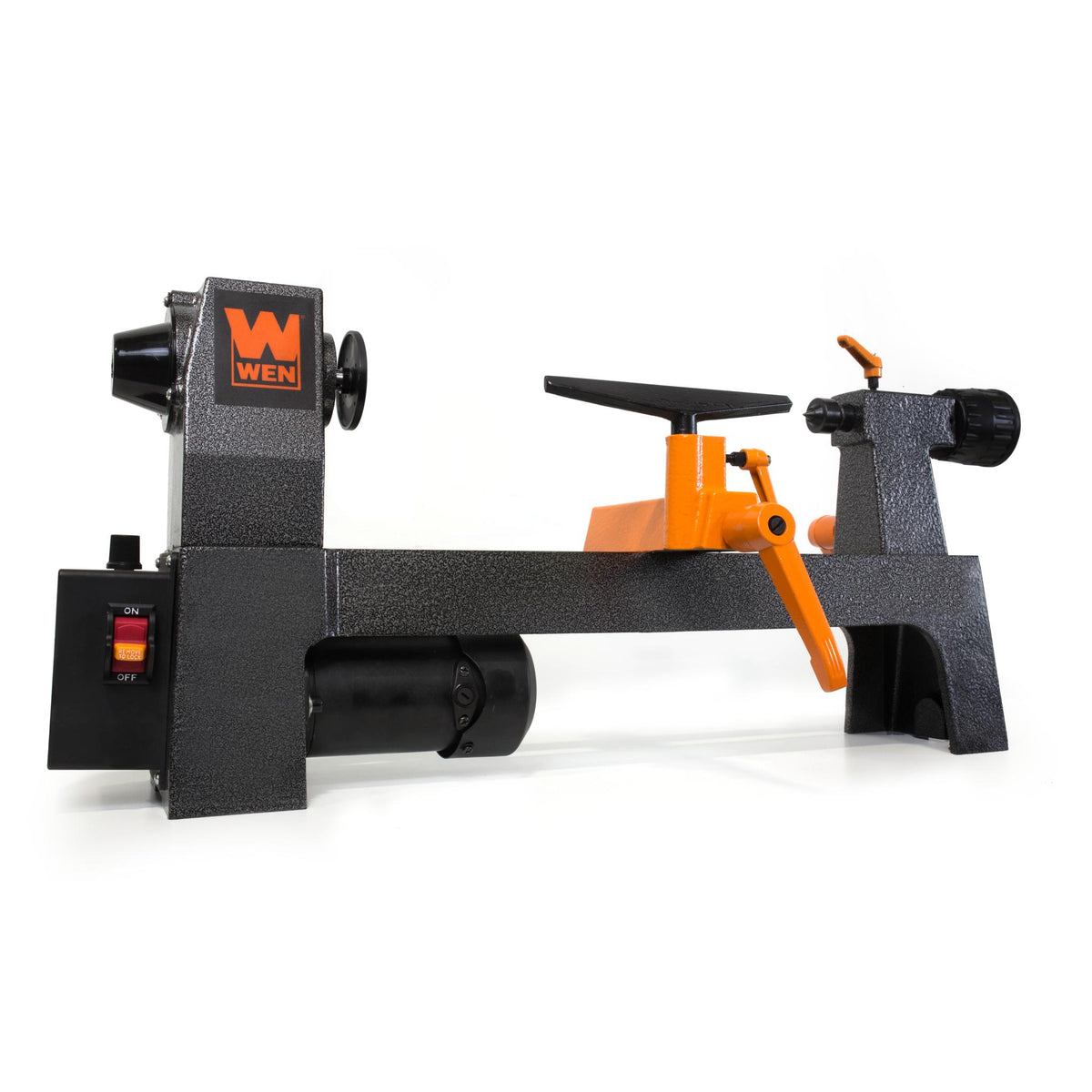
At a glance: 8-inch swing · 13 inches between centers · 3.2 A soft-start motor · 750–3,200 RPM variable speed · MT1 tapers.
If your usual work is a pen, chess piece, stopper, or small ornament, the LA3421 saves space without giving up a proper tool rest and tailstock. Its dial adjusts speed across a 750–3,200-RPM range, and the package includes two tool rests and a 2.3-inch faceplate. That makes it an approachable way to try spindle turning without dedicating a long bench to a lathe.
The 8-inch swing is a ceiling, not a comfortable target size for a rough or off-center bowl blank. Its 750-RPM minimum is less forgiving of an unbalanced workpiece than the lower settings on the JET and Laguna. WEN also uses MT1 tapers here; an MT2 mandrel or center purchased for the larger machines in this guide will not fit directly. Choose the RIKON instead if you expect to grow into a broader 10-inch lathe accessory setup.
Model details: WEN LA3421 specifications.
At a glance: 10-inch swing · 15½ inches between centers · ½ HP · three variable-speed pulley ranges · 200–3,600 RPM overall · MT2 tapers.
The JWL-1015VS earns its place for turners who want an electronic speed dial and a genuinely slow starting range in a 10-inch lathe. Across three belt positions, JET specifies 200–1,050, 300–1,750, and 600–3,600 RPM. You still move the belt to change ranges, but you can adjust speed within each range without stopping to change pulleys again. That is useful when you go from shaping a small blank to sanding or finishing.
Its cast-iron construction, common MT2 tapers, 1-inch by 8-TPI spindle nose, and 24 indexing positions make it a flexible small-shop choice. JET lists a five-year warranty and a net machine weight of 72.6 lb. It has less between-centers length than the RIKON, so check your longest planned spindle and allow room for a chuck or drill bit. The JWL-1015VS is the variable-speed model; do not confuse its listing with the belt-only JWL-1015.
Model details: JET JWL-1015VS specifications.
At a glance: 10-inch swing · 14 inches between centers · 1 HP · three variable-speed ranges · 250–3,200 RPM overall · 95 lb.
The Revo 10|14 is for a turner who has room for only a short lathe but wants a stronger, more substantial machine. Laguna specifies a 1-HP motor, cast-iron headstock and tailstock, digital RPM display, and three electronic-speed ranges: 250–850, 430–1,450, and 950–3,200 RPM. The low range is valuable when starting work cautiously, while the MT2 tapers and 1-inch by 8-TPI spindle accept many standard small-lathe accessories.
There is a trade-off: at 95 lb, this is compact in length, not especially portable. Its 14-inch between-centers capacity is also shorter than the RIKON’s. The larger motor does not expand its 10-inch diameter limit or make an uneven blank safe at high speed. If you mainly turn pens and rarely need extra torque, the less expensive machines above may be a better fit; if you expect regular bowl and spindle work in a tight shop, the heavier Laguna is compelling.
Model details: Laguna Revo 10|14 specifications.
At a glance: 1⅗-inch swing · 10 inches between centers · 100 W · 1,000–5,000 RPM · six included collets.
The DB 250 is the specialist here. PROXXON designed it for dollhouse parts, model railway details, miniature columns, and other very small pieces. A variable-speed control and included collets make sense for that scale, and the slim machine occupies much less space than a conventional cast-iron 10-inch lathe.
Its 40 mm (about 1⅗-inch) swing is dramatically smaller than the WEN’s 8 inches. It cannot replace a regular mini lathe for small bowls, larger ornaments, or most typical woodturning chucks and mandrels. PROXXON uses its own workholding system rather than the MT2 and 1-inch by 8-TPI combination on the RIKON, JET, and Laguna. Buy this one because your projects are truly miniature, not simply because the word “mini” appears in its name.
Model details: PROXXON DB 250 specifications.
Pens and narrow spindle projects require less swing than bowls. The PROXXON suits model-scale objects; WEN’s 8-inch class suits small conventional turning; the three 10-inch machines offer more clearance and a broader accessory path. If you regularly plan larger bowls or long table legs, look at a midi lathe instead.
A low starting speed matters for a rough or slightly unbalanced blank. The WEN starts at 750 RPM and the RIKON at 500 RPM; the variable-speed JET and Laguna can start at 200 and 250 RPM respectively in their low belt ranges. Maximum RPM alone tells you little about the machine’s usefulness for careful roughing. Follow the maker’s instructions for blank size, mounting, and speed rather than applying one universal RPM formula.
The WEN LA3421 has MT1 tapers. The RIKON, JET, and Laguna use MT2 tapers and 1-inch by 8-TPI spindles. The PROXXON has its own small collet and chuck system. A pen mandrel, drill chuck, live center, or four-jaw chuck needs the correct fit; “mini lathe accessory” by itself is not a compatibility specification. A faceplate and centers are useful starting points, while a chuck is often a separate purchase.
Measure the bench, not just the lathe’s body. Leave room to move the tailstock, handle long tools, reach the switch, and keep chips away from surrounding equipment. A 75- or 95-pound mini lathe deserves a rigid, level surface. The site’s machine footprint comparison tool can help when several machines compete for one workspace.
Wear a full face shield whenever the lathe runs. Tie back hair, remove loose clothing and jewelry, and do not wear gloves near rotating work. Before starting, secure the blank and both locking assemblies, then turn the work by hand to confirm it clears the tool rest. Start at a suitably low speed, step out of the workpiece’s line of fire at startup, and stop the machine before adjusting the rest. The American Association of Woodturners’ safety guidance is a useful companion to the manual for your exact machine.
Yes, if you expect to make pens, small ornaments, knobs, and short spindle projects. If bowls or a wider range of chucks are already on your list, a 10-inch machine with MT2 tapers provides more room to grow.
No. A fixed-speed lathe such as the RIKON works well if you are comfortable changing the belt to select one of its five speeds. Electronic adjustment is convenient for frequent changes, but the JET and Laguna still use different belt ranges to cover their full RPM span.
Some small bowls are possible on conventional 8- and 10-inch models when the blank fits, is sound, mounts securely, and can be turned at a suitable speed. Swing is a maximum clearance measurement, not a suggested bowl diameter. The PROXXON DB 250 is for miniature details rather than ordinary bowls. For more capacity, compare midi lathes and match your turning tools to the project; the bowl gouge guide covers that tool choice.
Check the taper or mounting method first. MT1 and MT2 are different sizes, and the PROXXON system differs again. Confirm the exact model and mandrel fit before ordering.
For most first-time turners with a sturdy bench, choose the RIKON 70-105 for its cast-iron build and 10-by-18-inch capacity. Choose the WEN LA3421 for pens and very limited space, the JET JWL-1015VS for convenient speed changes, or the Laguna Revo 10|14 when you want more power within a short bed. The PROXXON DB 250 is the right answer only when your projects are genuinely miniature.