

As an Amazon Associate I earn from qualifying purchases.
For most plastic model kits, Gunpla, and tabletop miniatures, the Iwata Eclipse HP-CS is the best one-airbrush choice. Its 0.35 mm head covers smooth basecoats, gradual shading, and most detail work without pushing beginners toward an easily clogged ultra-fine nozzle.
Start with the Harder & Steenbeck Ultra 2024 if learning trigger control is your priority. Choose the GSI Creos PS-289 if you want a 0.3 mm model-focused airbrush with adjustable airflow. The best option changes when you primarily spray primer, cover large tanks, or paint tiny freehand details.
Before you buy: These recommendations are primarily airbrushes, not complete compressor kits. A usable model-painting station also needs a compressor, regulator, moisture trap, compatible hose or adapter, suitable paint and thinner, and effective spray-mist control. We cover those choices below.

The most practical one-brush choice for basecoats, shadows and general model detail.

A 0.45 mm beginner-oriented model with helpful trigger and cleaning features.

A capable 0.3 mm option for Gunpla, military kits and careful paint control.
All seven use gravity feed and dual-action controls. The differences that matter are nozzle size, how easily the tip is serviced, spray coverage, and what kind of painting you do most often. Product names link to the detailed reviews.
| Model | Nozzle | Choose it for | Main limitation |
|---|---|---|---|
| Iwata Eclipse HP-CS | 0.35 mm | One airbrush for most model projects | Needs a capable compressor |
| Harder & Steenbeck Ultra 2024 | 0.45 mm | First-time painters, priming and basecoats | Not the first pick for hairline detail |
| GSI Creos PS-289 | 0.3 mm | Gunpla, gradients and general detail | Smaller tip benefits from well-thinned paint |
| Harder & Steenbeck Evolution 2024 CRplus Solo | 0.28 mm | Frequent painters wanting more precise control | Solo package has only one head size |
| Badger Patriot 105 | 0.5 mm | Primer, varnish, scenery and larger models | Broad-work focus; check hose fitting |
| NEO for Iwata CN | 0.35 mm | Lower-cost first or backup airbrush | Less paint-flow headroom than Eclipse |
| GSI Creos PS-270 | 0.2 mm | Experienced painters doing controlled fine lines | Unforgiving of thick primer and dried tip |
Package caution: a standalone airbrush listing is not a compressor kit. The Evolution Solo is not the Evolution 2-in-1, and the Eclipse HP-CS bare tool is not the Eclipse Value Set. Check the exact seller-selected package before ordering.
Match the main job first. These are practical starting directions, not spray-test rankings.
An Eclipse HP-CS or PS-289 handles camouflage transitions, basecoats and varnish with sensible thinning.
The Ultra 2024 is approachable for zenithal highlights, batches and controlled first-session practice.
The Patriot 105 or Ultra 2024 usually offers a less fussy route through primers and large pieces.
The PS-270 or Evolution Solo rewards careful paint preparation, close control and frequent tip checks.
For a first airbrush, prioritize reliable atomization and replaceable parts over the smallest advertised nozzle. A clean 0.35 mm brush at the right pressure often does more useful work than a 0.2 mm brush that constantly blocks.
Model ECL4500 · One-tool versatility · Airbrush only
Quick specifications: 0.35 mm E3 head system; dual-action, gravity-feed; 7 ml cup with lid; compression-fit nozzle; Iwata lists 25–35 psi as its optimal working-pressure range.
The Eclipse HP-CS earns the overall recommendation because a scale modeler needs to switch between an aircraft wing, a miniature cloak, a tank turret and a smooth clear coat without constant hardware changes. Its high-flow, compression-fit head is more tolerant of different paint consistencies than many dedicated detail brushes while retaining controllable fine-to-medium spray.
The drop-in nozzle is the practical feature that makes it easier to live with. When dried acrylic causes sputtering, access to the nozzle and needle is less fiddly than a tiny screw-in setup. It also has widespread replacement-parts support. That matters more over several years than a flashy nozzle-size claim.
The compromise is that it is not the most specialized tool for very tight freehand mottling. It also asks more of a compressor than some very-low-pressure starter brushes. Verify you are buying the bare ECL4500 rather than a different bundle, and confirm the seller is authorized: Iwata has published a warning about counterfeit Eclipse HP-CS products on marketplaces.
Choose it if
You build a mix of Gunpla, aircraft, cars, armor and miniatures and want one dependable brush for most paint sessions.
Skip it if
Your priority is only extremely fine freehand detail, or your compact compressor cannot maintain the airflow the Eclipse needs.
Model 120231 · 0.45 mm · Guided control features
Quick specifications: 0.45 mm head set; 5 ml removable cup plus built-in micro-cup socket; dual-action gravity feed; Start Control, Colour Control and Clog Control.
The Ultra 2024 takes a different approach from a generic beginner airbrush. Harder & Steenbeck built a trigger system intended to teach the correct sequence of air first, then paint; its stepped Colour Control setting gives repeatable travel limits while you learn priming, basecoating and highlighting.
Its open-access tip area makes checking and wiping dried paint easier. The 0.45 mm standard head is a strength for first-time users spraying airbrush-ready paints, primer and basecoats: it is more forgiving than a very fine nozzle. The 5 ml removable cup is also easy to work around when cleaning.
This is not simply an inferior Evolution: it is optimized for a different person. You can change compatible head components later, but a fine-detail conversion costs extra. Most hobbyists should learn on its supplied 0.45 mm head before paying for a narrower one.
Choose it if
You want your first proper dual-action airbrush and value a clear learning path over maximum fine-detail specifications.
Skip it if
You already handle a dual-action brush confidently and want the 0.28 mm detail head included rather than purchasing it separately.
Model PS289 · 0.3 mm · Air adjustment control
Quick specifications: 0.3 mm nozzle; 10 ml cup; gravity-feed dual-action; fingertip air adjustment, soft trigger and air-up mechanism.
The PS-289 is a compelling alternative if you build Gunpla, tanks or plastic aircraft and want well-controlled gradients, clear coats and finer shading from one 0.3 mm brush. The built-in airflow adjustment offers a convenient local trim without reaching for the compressor every time you change from coverage to a closer detail pass.
That control does not replace a proper regulator at the compressor. It simply adds another way to refine airflow at the tool. Its 10 ml cup is useful when spraying a larger model, but the tall cup may feel less open around tiny figures than a low-profile design.
Compared with a very fine 0.2 mm brush, the PS-289 is easier to recommend as an all-purpose tool, especially for modellers who mainly spray well-thinned hobby acrylics or suitable lacquers. Take care with solvent ventilation and the paint maker’s recommended thinner.
Choose it if
You want a 0.3 mm general-purpose model airbrush with fingertip air adjustment and a good balance between gradients and coverage.
Skip it if
You mainly spray heavy primers without much thinning or want the simplest possible nozzle-cleaning system.
Model 121231 · Solo 0.28 mm configuration · Airbrush only

Quick specifications: 0.28 mm FineLine head; 2 ml cup in the Solo configuration; gravity-feed dual-action; redesigned trigger and easy-to-service head system.
The Evolution 2024 CRplus Solo is a strong step up if you already enjoy painting and want a smoother transition between a small highlight and a medium-size pass. The redesigned trigger feel and modular head are the real reasons to choose it, not an assumption that a smaller nozzle guarantees a finer finish.
The standard Solo package is a 0.28 mm setup with a 2 ml cup. That is excellent for controlled highlights and small paint volumes, but it is not a wide-coverage starter kit. Harder & Steenbeck also offers 2-in-1 configurations with an additional head size; do not assume those extra parts come in the Solo listing.
If you frequently paint both large vehicle bodies and tiny freehand patterns, a second larger head or a separate broader-work airbrush may make more sense than asking this one tool to do everything.
Choose it if
You are a regular painter who values trigger response, modular servicing and a more dedicated 0.28 mm setup.
Skip it if
You want a one-box 0.28/0.45 mm conversion kit, or most of your work is broad primer and varnish application.
Model 105 · 0.5 mm standard setup · Broad-work specialist
Quick specifications: 0.5 mm standard needle/nozzle; dual-action gravity feed; self-centering head arrangement; approximately 1/3 oz paint cup.
For spray primer, varnish, terrain boards and larger armored vehicles, the Patriot 105 deserves serious consideration. Its standard 0.5 mm setup provides more room for properly prepared primers and broader coverage, where tiny nozzles often add little value and much more cleaning.
The big benefit is practical: you can basecoat a batch of scenery or prime a tank without constantly fighting a narrow paint passage. It can produce modest detail with practice, but it is not the ideal first choice if you want narrow freehand camouflage spots on small aircraft.
Check the connection before buying a new hose: Badger air fittings are not automatically the same as a standard 1/8-inch hobby airbrush fitting. Plan for the correct hose or adapter, and confirm which needle/head variant the specific listing includes.
Choose it if
Most of your spraying is primer, basecoats, varnish, bigger scale-model panels or scenery.
Skip it if
You want fine detail on very small miniatures and do not intend to keep a second, more precise airbrush.
Model N4500 · 0.35 mm · Low-pressure-friendly
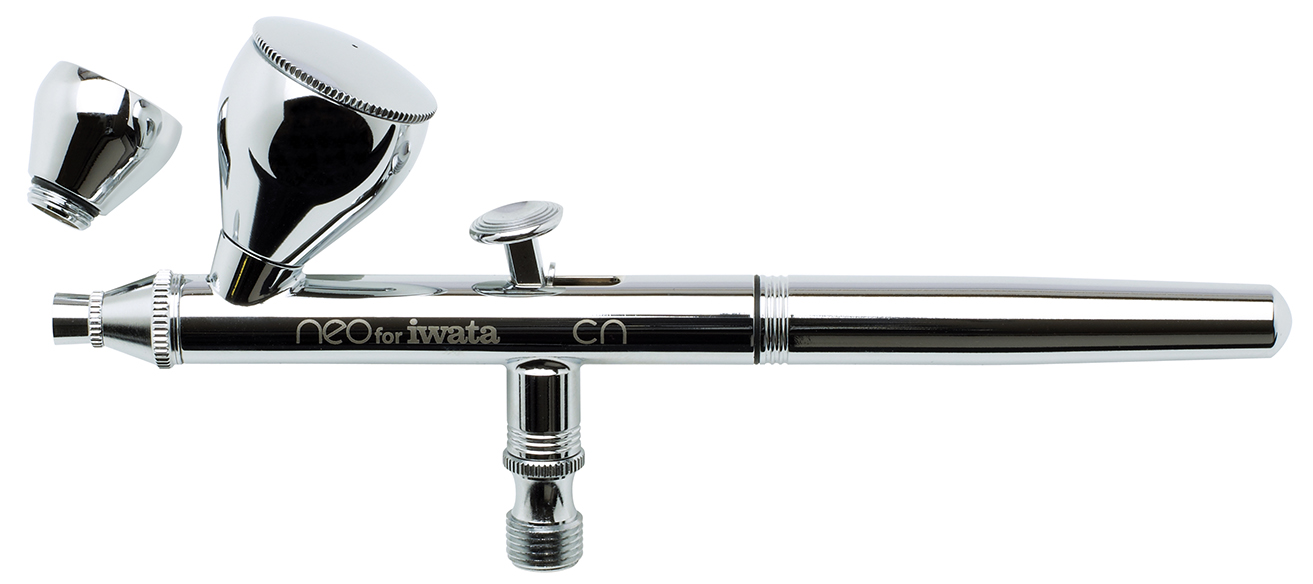
Quick specifications: 0.35 mm N3 screw-on nozzle; 3 ml and 7 ml removable cups; gravity-feed dual-action; Iwata lists 8–20 psi as its optimal working-pressure range.
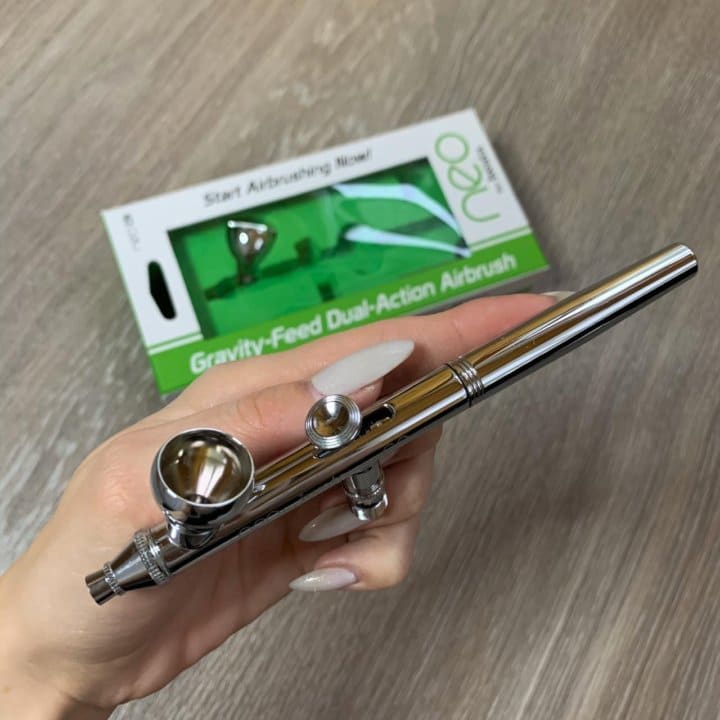
The NEO CN is the budget-minded way into a recognizable, serviceable airbrush ecosystem. Its two removable paint cups are useful: use the smaller cup when practicing dots and lines, then the larger cup when covering a model body. Iwata specifically designs it to work well with lower-pressure air sources.
It is good for learning paint consistency, basecoats and simple highlights without paying Eclipse money immediately. However, it has a more conventional screw-on nozzle, and it lacks the same high-flow head design that makes the Eclipse so forgiving of varied material viscosities.
A bare NEO CN is not the NEO compressor starter kit. If you do not already own an air source, calculate the price of compressor, regulator, hose, moisture trap and safety equipment before deciding which option is cheaper overall.
Choose it if
You are starting on a constrained budget or want a second, lighter-duty airbrush for small batches of color.
Skip it if
You routinely spray thick primers or need a forgiving all-purpose tool for high-volume model sessions.
Model PS270 · 0.2 mm · Specialty detail brush

Quick specifications: 0.2 mm nozzle; 10 ml cup; dual-action gravity feed; adjustable airflow and soft-trigger features.
If your work involves intricate freehand camouflage on 1/72 aircraft, subtle mottling, panel-adjacent shading and detailed figure highlights, the PS-270 is the specialized choice. It is intended for thin paint, close control and painters who already know how to manage trigger movement and airflow.
The small 0.2 mm setup is not automatically more precise in inexperienced hands. It is more sensitive to dry tip, pigments that are not sufficiently dispersed and overly thick primer. Many model builders get better results from a 0.3–0.35 mm airbrush until their paint preparation and trigger technique are repeatable.
Use it to complement an everyday airbrush, not as a universal replacement for broad coverage. Its 10 ml cup is relatively generous for detail work, so some painters may prefer to load only a small amount at a time.
Choose it if
You already have a reliable general-purpose airbrush and want more control over very fine freehand shading.
Skip it if
This would be your first brush, or you predominantly spray primer, metal flakes or heavier coatings.
Nozzle diameter influences paint throughput and how easily a brush handles pigment, but it does not determine line width on its own. Paint reduction, pressure, needle position, distance, and hand stability all contribute. Think of nozzle size as a workload choice rather than a contest to buy the smallest number.
Illustrative job-fit comparison: longer bars indicate more preference for broad, less-fussy coverage, not measured spray width.
Tip: if you only own one airbrush, the middle size is usually the safer choice. Check the paint manufacturer’s particle and thinning guidance.
Use the site’s Airbrush Needle/Nozzle Size Finder to narrow the job, then decide whether you really need a second nozzle or another airbrush.
An expensive airbrush connected to the wrong air supply will not make a smooth coat. Before ordering, check this practical shopping list:
If you still need a compressor, start with our Airbrush Compressor Finder or airbrush compressor buying guide. For a complete one-box alternative rather than a stand-alone brush, compare our airbrush starter kits.
Water-based miniature acrylics: convenient for indoor model work, but spraying still produces inhalable particles. Some bottled paints are airbrush-ready; others need the manufacturer-recommended reducer and careful mixing. Do not assume tap water is the correct thinner for every acrylic line.
Hobby lacquers and solvent-based enamels: can produce attractive smooth finishes for plastic aircraft, vehicles and Gunpla, but require compatible solvents, suitable extraction and respiratory protection assessed for both mist and vapors. An ordinary dust mask does not protect against solvent vapors. Follow the manufacturer’s safety data sheets and avoid ignition sources.
Primers and varnishes: are where a 0.35–0.5 mm airbrush earns its place. Fine 0.2 mm heads can clog or dry at the tip unless the product is expressly suited to them. Test on a spoon or spare sprue before spraying the finished model.
Avoid universal thinning ratios
The same “2 drops of thinner per 1 drop of paint” advice does not work across Vallejo, AK, Tamiya, Mr. Color and every primer. Start with the paint manufacturer’s instructions; change one variable at a time after a test spray.
Our paint thinning calculator helps you choose a starting point, but always give the paint manufacturer’s directions priority.
These are conservative starting ranges for testing, not machine pressure limits or universal standards. Read the pressure at the regulator while holding the trigger down, and test against the paint manufacturer’s recommendations. Thin paint, narrower heads and close work often use less pressure; heavier material may need more. Your airbrush brand may specify a different optimal range.
| Task | Test starting point | What to watch |
|---|---|---|
| Close detail and pre-shading | About 10–18 psi | Use thin paint and a small, controlled trigger pull. Increase pressure if atomization is poor. |
| Everyday basecoat / gradients | About 15–25 psi | Start in the middle, spray a test piece, and adjust for the paint and nozzle. |
| Primer or broader coverage | About 18–28 psi | A larger head may help. Check primer guidance and avoid blasting wet coats. |
For example, Iwata lists 25–35 psi as the Eclipse HP-CS optimal range and 8–20 psi for the NEO CN. That is a reminder to treat all generic hobby pressure charts as starting points, not as substitutes for a product manual. You can also use our PSI Setting Guide.
This three-part movement is more important than expensive upgrades.
Press the trigger to release air before moving onto the model. Keep the brush moving.
Pull back gradually to add paint. The further back you pull, the more color is delivered.
Push forward to stop paint while maintaining airflow briefly, then release the trigger.
A beginner practice session should use a card or a primed plastic spoon: paint dots of equal size, five slow straight lines, a soft gradient from a few centimeters away, then a small circular highlight. Once these are consistent, move to a spare sprue or low-stakes model part. Avoid learning the controls on the finished miniature.
Start with the least invasive fix; never force a needle or scrape a delicate nozzle with hard wire.
Drain the moisture trap, clean the needle tip, then spray on scrap with a fresh small mix.
Wipe the needle gently with the correct cleaner; try approved retarder and reassess distance.
Spray a little closer, adjust reduction and air, and apply lighter controlled passes.
Reduce paint trigger travel, increase movement speed and let each pass flash off.
Stop spraying; check the correct seals and clean/reseat the head per its manual.
Test a drop of approved thinner, clean the nozzle carefully, and inspect the needle for damage.
If one problem keeps returning, check whether the paint was mixed thoroughly, whether your thinner matches the product line, and whether the compressor maintains pressure under load. A different airbrush is rarely the first fix for a bad mixture.
Tip: the Eclipse drop-in nozzle, Ultra’s accessible head and Evolution’s modular head each make certain routine maintenance tasks easier, but every brand has its own needle and seal arrangement. Use genuine, model-specific replacement parts.
Airbrushing creates fine paint mist even when the paint is water-based. The safest practical setup captures overspray near the model and exhausts it appropriately, following the booth’s instructions and the paint safety data sheet. A fan blowing aerosol across the room is not the same as effective extraction.
For solvent-based lacquers and enamels, evaluate organic-vapor exposure and fire risk in addition to particles. A loose dust mask is not suitable vapor protection; choose a properly fitted respirator and cartridges or filters appropriate for the product and local guidance. Do not use unapproved electrical equipment around flammable solvent vapor, and do not spray close to flame or sparks.
Marketplace authenticity warning
Iwata warns that counterfeit Eclipse HP-CS (ECL4500) airbrushes have been sold through third-party marketplaces. Before buying, verify the seller and inspect the product using the manufacturer’s authenticity checklist.
The Harder & Steenbeck Ultra 2024 is the easiest first recommendation because it teaches double-action control and uses a forgiving 0.45 mm head. The NEO CN is a worthwhile lower-cost alternative, especially with a small compressor.
Not usually as a first purchase. The 0.2 mm class is better reserved for well-thinned detail work and more experienced technique. A 0.3–0.35 mm brush is a more versatile middle ground.
Yes, if the materials are compatible with the airbrush, properly reduced and cleaned between products. For heavier primers and large pieces a 0.45–0.5 mm setup is often more convenient.
A tank is useful for steadier delivery, fewer motor cycles and often quieter operation, but an adequate tankless compressor can work for lighter hobby use. A regulator, moisture management and reliable airflow matter more than tank size alone.
Yes, with compatible cleaning and appropriate thinning for each product line. These paints do not all use the same thinner: follow the specific paint instructions and avoid mixing incompatible solvents.
You still need to control aerosolized particles and prevent overspray from circulating through living space. Use suitable extraction and protective measures, and read the paint SDS. Water-based does not mean harmless when aerosolized.
Residual dried paint, poor mixing, incompatible thinner or insufficient tip cleaning are common causes. Flush thoroughly between colors and inspect the needle tip before disassembling the whole brush.
No. The specific listings here are standalone airbrushes or their own non-compressor packages. For a complete starter setup, compare our airbrush kit guide and check the exact included components.
The standard gravity-feed Eclipse HP-CS (ECL4500) uses the 0.35 mm E3 head. Do not confuse it with other Eclipse configurations or assume every Eclipse model has the same nozzle.
There is no universal distance. Move closer for careful fine detail with sufficiently thinned paint and controlled airflow; move farther for broader, lighter passes. Practice first on spare plastic rather than using a fixed distance for every paint.
Best all-rounder: Iwata Eclipse HP-CS. Best for a first airbrush: Harder & Steenbeck Ultra 2024. Best model-focused value: GSI Creos PS-289. Choose a Patriot 105 for heavier primer jobs, or a PS-270 / Evolution Solo only when you have a clear need for tighter detailing.
A carefully prepared paint mix, stable air supply and clean needle usually improve model finishes more than jumping straight to a smaller nozzle. Start with the workflow you will actually use, then build your kit around it.